Friday, September 27, 2013

Family Bonds--Fast Forwarding the Years

Getting together with my first cousins in August reminded me of how quickly time passes, leaving memories a bit faded, but the impressions as vivid as ever.  We shared a few precious visits together during our youngest years, and they were very bonding experiences.  One visit occurred when I was about two and a half years old.  Dad drove me down to Campbell, California from our home in Richmond so that I could stay with my mother's sister, Phyllis Rice, while Mom was in the hospital for a routine procedure.

Although I do not remember the exact event, my cousin Cheryl tells me that before Dad even left to go back home, Cheryl and I managed to get into a jar of Vaseline and experimented with it as beauty cream and hair gel.  She chided me that while Dad took me immediately to the bathtub to scrub the sticky grease out of my hair, she was left to deal with her own unfortunate circumstances.  Being the only girl in a family with two boys, she was often expected to be a tad more responsible than her years.  She probably also had to look out for me after Dad's departure, being the elder of us two girls.  Ah, the unfairness of childhood.  And, we were off to such a fine start with the Vaseline incident!  I'm sure that Dad drove away wondering if Aunt Phyllis would ever want to babysit me again.


"Our Gang" in 1956

Three siblings and a first cousin at the Rice home in Campbell, California, 1956.  Left to right:  Curtis Rice, Chery Wheeler (me), Craig Rice, and Cheryl Rice.  Cheryl and I are wearing matching dresses with multi-colored pockets, made for us by my mom.


My cousins and I had a grand time during those visits in Campbell.  I have always felt sorry that my sister was born a few years too late to be a part of it all.  We were all about the same age, with Craig born the same year as me, Cheryl one year older, and Curtis, the eldest, was two years older.  We often resembled a step ladder while standing all together.  I was a little frightened and lonely after Dad drove off and left me behind for that first stay of about a week.  Being so young, I did not understand what had probably been explained to me quite thoroughly, about staying with my aunt and cousins for a short period of time until my parents could return for me.

That visit at age 2-something is the first real memory I have of my aunt and cousins, though they were familiar to me at the time from our earlier get-togethers in Richmond, where my parents lived and where my Aunt Phyllis lived before moving to Hanford, and then Campbell.  After allowing myself to mope a little about being left behind, I set about to have some fun with my cousins.  We spent hours tearing around as Cowboys and Indians, and climbed on the dead tree trunk in the yard.  We scrounged for prune plums through and over the fence of a nearby orchard, and hunted polliwogs, caterpillars, and other unsuspecting creatures.  We caught glimpses of shows like "Annie Oakley" and "Tugboat Annie" on my aunt's console television while waiting to get our hair washed in the huge laundry room sink.  At meal times, I admired the multi-colored octagonal Fiesta ware plates that my food was served on.  I was just starting to get used to the idea of hanging out with my cousins when my parents returned to take me home again.


"Our Gang" in 2013

Three siblings and a first cousin at the wedding of Matthew and Chelsea (Johnson) Rice in Aurora, Oregon, August 17, 2013.  Left to right:  Curtis Rice, Chery (Wheeler) Kinnick, Cheryl (Rice) Nibler, and Craig Rice (father of the groom). Although it was not planned, Cheryl and I are again wearing clothes with  a similar pattern and colors!

I still enjoy hanging out with my cousins whenever I have the opportunity, which has not been frequent due to our inevitably busy family lives and work schedules, plus the driving distance between states.  But, we have found ourselves in each other's company a couple of times over the past several years, as our children graduate from college and settle down to married life.  Soon, those children will have children of their own, and there will be new little cousins to form bonds with each other.  The importance of extended family is sadly neglected in the increasing busy-ness of modern life.  But, I can say that whether my cousins and I are near or far from each other, it is comforting just knowing that Curtis, Cheryl, and Craig are out there, sharing some of the same childhood memories and family experiences.  I hope we will continue to have many such reunions as the years progress, though our activities and conversations are bound to be a bit more sedate than those of decades past!


Saturday, September 14, 2013

Identified: Ingebrigt Larsen Winje from Vinjeøra

I believe I have identified photographs of a member of the Winje branch of my family who emigrated from  Vinjeøra, Norway and arrived in America in 1869.  The history of Lars Eriksen Winje, his wife Ragnild, and sons, Eric and Ingebrigt, was discussed in my 2008 publication:  A Long Way Downstream:  The Life and Family of Thibertine Johnson Winje, Norwegian-American Pioneer.  The only photo of the entire family that I have seen is the one below, made available online through the Hemneslekt.net genealogy website.  Though the image is of poor quality, it is possible to determine facial features and family resemblances.  The carte-de-visite size photos of the parents, Lars and Ragnild (also below), were taken in Chippewa County, Minnesota.  Their eldest son, Eric Larsen Winje, has been clearly identified due to various family-held photos of him as an adult.  The only family member whose adult image had not been found or identified was Ingebrigt's... until now.


A positively identified photo of the Winje family, prior to
 emigrating to America.  Taken in Trondheim, Norway in 1869.
Seated in front are Ragnild and Lars, with Eric standing
behind his mother, and Ingebrigt behind his father.
Lars Eriksen Winje, ca, 1880
Montevideo, Minnesota


Ragnild Winje, ca. 1880
Montevideo, Minnesota


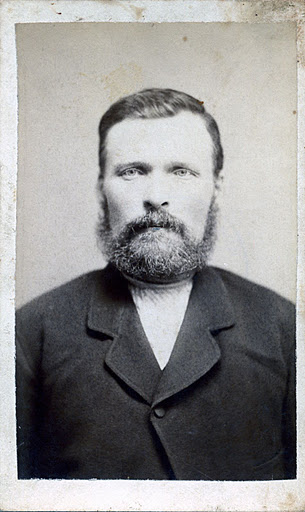
Among a batch of unidentified carte-de-visite size photos that once belonged to my great grandparents, Ole and Malla Johnson of Leonard, Minnesota, were the two images below.  The photos were taken in Montevideo, Chippewa County, Minnesota by the same photographer, A. Brandmo.   The features of the man on the right, in particular, haunted me for some time.  It finally occurred to me that the unknown man looked somewhat like Eric L. Winje, and when I thought to compare his image to the other male members of the immigrant Winje family, it became clear that he was, indeed, a Winje,  The members of that family were very limited during the 1870s and 1880s.  The only Winje it could be, according to the age of the man and the age of the photos, is Ingebrigt Winje, son of Lars and Ragnild Winje, and younger brother to Eric L. Winje.

 
Probably Ingebrigt Winje, ca. 1886,
Montevideo, Minnesota

Probably Ingebrigt Winje, ca. late 1870s,
Montevideo, Minnesota


Ingebrigt Winje was born at Vinje, Hevne, Sør-Trøndelag in Norway.  His parents were cotters (tenants) at Skeistrøa, and they later leased a lot at Vinjeøra.  At age 12, he came to America with his parents and brother, sailing on the Franklin and arriving by way of Quebec in 1869.  In 1870, he wrote back to a friend in Norway:

...I live well with my health and soundness and find myself here in America.  I have now gone to school one month and I had to begin anew with my ABCs which was very different pronunciation of them than in Norwegian.  ...I see from your letter that you ask me to write how it was with me at sea.  On the sea it was very fun and I had many friends there but I was not sick one single day.

The letter was signed "Yours faithfully, Ingebrigt Larsen."

Eric L. Winje (5 Dec 1850-8 Feb 1930), was six years older than his only brother, Ingebrigt.  Eric became one of the first licensed attorneys in Chippewa County, Minnesota, and studied law while "rocking the babies" and helping out his wife out at home.  After passing the Minnesota bar exam, he practiced law in Duluth and later was elected municipal court judge.  He also worked as an attorney in Sacred Heart and Detroit Lakes.  In comparing Eric's identified photo to the two unidentified men (above), it is clear that they possess many of the same facial features:  a broad forehead with the hair parted on the far left, high cheekbones, and a similar shape and size to the eyes and eyebrows.  Ingebrigt appears to have had the same wide, strong jaw as his father, Lars.

Official photograph of Eric L. Winje,
 ca. 1885.
Whereas Eric, the elder brother, chose to leave farm life behind and build a professional career, Ingebrigt stayed on his parents' farm in Sparta Township, Chippewa County, Minnesota, to help his aging father with the heavy labor.  If health had permitted, he would have inherited his parents' farm property and carried on much as his father had.  But, at age 31, he contracted diphtheria during an epidemic in Chippewa County and died on May 26, 1888.  "Black Diphtheria," as it was called, was a much-feared disease in which a membrane growth covers areas of the throat, resulting in airway obstruction and death in the most serious cases.

Several months after her uncle's death, 16-year-old Regina Winje, who was living with her uncle and grandparents on the Winje farm, wrote to a family friend from Norway who was temporarily living in Seattle, Washington:

I must now send you some lines as an answer to your letter to Ingebret [sic] Winje, since he can not.  Your childhood friend is dead!  He died the 26th of May 1888.  He was sick for nine weeks this winter from arthritis but  then he got a little better again, so much so that he could work, but then he became again lame in his right foot and had to in the end, be in bed and was so frightfully sick of two weeks that he lost his understanding right up until the last hour; his last hour he was, however, calm.  here there were many people who followed him to the grave...


The Winje farm in Sparta Township became the property of Ingebrigt's mother, Ragnild, after the death of her husband, Lars, in 1890, only two years after Ingebrigt's passing.  Lars and Ragnild Winje's eldest grandchild, Regina Winje Strand, then took over responsibility for the farm, along with her husband, Thomas E. Strand.  Strand eventually purchased the farm after his wife Regina passed away at young age in 1899, but he continued to support his grandmother-in-law, Ragnild Winje, until her death. 

Without direct descendants to carry on Ingebrigt Winje's memory, an impression of him as an adult has been indeterminable for some time.  But, I am now fairly confident that we have rediscovered an image of a much loved Norwegian-American son, brother, and uncle.


Ingebrigt Larsen Winje
Born:  12 September 1856, at Vinje, Hevne, Sør-Trøndelag, Norway
Died:   26 May 1888, Sparta Township, Chippewa County, Minnesota
Buried:  Saron Lutheran Cemetery, Chippewa County, Minnesota
Occupation:  farmer


*****

Sources:

--Winje, Ingebrigt Larsen, letter to Wessel family of Vinjeøra, Norway, 1870.  Courtesy of Astri Wessel, Nord-Trøndelag, Norway.
--Winje, Regina E., letter to Doran Wessel in Seattle, Washington from Chippewa County, Minnesota, October 1888.  Courtesy of Astri Wessel, Nord-Trøndelag, Norway.


Wednesday, September 11, 2013

"Try to Forget Me and Be Happy"


Ella Pederson Drews

"When you're down and out, nobody likes you"

Ella Mathilda Pederson, ca. 1894/95;
 a serious looking young girl 
Saved between the pages of an old Pederson family Bible are a couple of letters written by a woman on the west coast to an older brother in the Midwest--a brother she had probably not seen for years.  Alfred (Fred) Pederson resided on the family farm in Northland Township, where they had both lived with their parents while growing up.  Fred kept two letters from his younger sister, Ella, and placed them inside the Bible for safe keeping.  Many years later, they were still in the possession of one of Fred's grandsons, in the exact same place.  It was through the loaning of that Bible from cousin to cousin that I eventually learned a little about Ella, who, unarguably, was a child of misfortune.

Ella's mother, Karin (Larson) Pederson, was an older sister to my maternal great grandmother, Malla (Larson) Johnson.  Karen and her husband, Erik Stallen Pederson, became farmers in Northland Township (East Grand Forks area), Polk County, Minnesota during the late 1870s.  They had four children:  Fred, Klara, Ed William "Willie", and Ella.  The Pedersons are a branch of the family I have known little about, until now.  What is now realized about Ella's experiences, though told in her own words. is just the tip of the iceberg and does not fully represent the trials she began to face at a very early age.

As a young girl in the cropped photo above, Ella Pederson looks older than her tender years.  But, it is unmistakably Ella, with her uniquely crooked nose and mouth--both slightly pulled downward on the left side of her face--and her prominent, knobby chin.  She appears quite the same as in the photographs of her as a younger girl (see below).

This is probably the early Pederson farm in Northland Township, Polk County, Minnesota.  The photo belonged to Malla (Larson) Johnson, a sister of Karen (Larson) Pederson.  On the verso is Malla's handwriting in Norwegian:  "Denn farm var Karen dem er dode" (Loosely translated:  "The farm where Karen had died").

Ella and her siblings dealt with a double tragedy in 1892, when their parents died within months of each other.  Both contracted tuberculosis (consumption), probably at around the same time.  "TB" was a common disease among young adults, and was often spread by drinking raw cow's milk--a dietary staple of farming folk.  The children's mother, Karin, died on January 9, 1892, and their father, Erik, on May 17 the same year.  Ella, their youngest, was nearly 5 years old at the time.

The untimely deaths of both parents left the eldest sister, Klara, with much of the responsibility to care for her sister and brothers. Klara was only 13 when she was suddenly laden with this heavy responsibility.  Unfortunately for all, Klara also contracted tuberculosis and passed away three years later, on June 8, 1895.  The Minnesota Territorial census for Northland Township during the summer of 1895 lists Ella as living alone with her brother, Fred.  One can imagine that as the only remaining female in the household, though just 8 years old, Ella must have had a daily round of chores that taxed her well beyond her years and capabilities.  As for her brother, Fred, it was undoubtedly a lot for him to assume the role of "man of the house" as a youth, and he deserves credit for keeping the rest of the family together for as long as possible after the deaths of his parents and sister.  Relatives local to the area must have helped the children, but it is unknown just how much assistance was offered, and/or how much of presence they really had in the household.  The children may also have taken turns living with other family members or friends in order to attend school, or just for security reasons.


The children of Erik and Karin Pederson of Northland Township, Polk County, Minnesota, ca. 1890.  Left to right:  William ("Willie"), Ella, Alfred ("Fred"), and Klara Pederson.
Ella Pederson (left) with her sister, Klara Pederson,
 ca. 1892.

Ella must have continued to live with her eldest brother, Fred, on their parents' Minnesota farm until close to the date of her marriage.  At age 23, she married Adolph Karl Drews in Seattle, King County, Washington, on October 23, 1910.  It is possible that she eloped to the west coast with Adolph, and in doing so, may have been judged in a negative light by some friends and family back home.  Witnesses for the couple's wedding in Seattle were E. Johnson and Jennie (?) Peterson.  Adolph, the groom, was 12 years Ella's senior.  He was born to a German couple on March 21, 1875, in Poland, and arrived in the United States in 1900.  If Ella had married a foreign national a few years earlier, she would have been required by law to renounce her U. S. citizenship according the to Expatriation Act of 1868.  Happily, she was not required to make the difficult choice between marriage for love versus keeping her native-born citizenship, for the law was altered in 1907.

A son, Arthur, was born to Adolph and Ella on April 22, 1911, just six months after their wedding.  Their address in the 1912 Seattle City Directory was  listed as 127 Victoria Avenue, but they moved to 1737 Victoria the following year.  Work was difficult to find at that time in Seattle, and even more difficult to keep.  The United States was in a recession just prior to World War I.   Many Midwesterners headed for the west coast in hope of finding work, but economic difficulty was widespread.  For the average unskilled laborer, job hunting would not improve until a few years later.  Once the war began, Europeans began purchasing U. S. goods for war and American manufacturing jobs became more numerous.  Also, when the U. S. became involved in the war in 1917, the military draft helped to lower the unemployment rate.

By 1914, Adolph had moved on to Portland, Oregon in hope of finding work.  Between 1914-1916, the family seemed to change addresses in Portland at least once a year, living first at 288 Jefferson, then 201-1st St., followed by 285 Hall Street.  The frequent change in address may have been due to difficulties with meeting the rent, which Ella alludes to in her letters.  One challenge her husband faced while seeking employment was the negative reaction he may have received as a German immigrant in the United States during World War I.  It was a time when many Germans were viewed with suspicion, and sometimes with downright hatred.  An example is the war propaganda of a Liberty Bonds poster (now in the public domain) depicting the German soldier as an evil "Hun."


"Beat back the HUN with LIBERTY BONDS." - NARA - 512638

"Beat back the HUN with LIBERTY BONDS"- NARA - 512638.jpg 

In 1914, Ella wrote a lengthy letter to her elder brother, Fred, who was still living on the family farm in Northland Township, Polk County, Minnesota.  Dated November 30, the envelope displayed a return address of "Mrs. A. Drews - 301 1/2 First Street, Portland, Oregon."  She was responding to a letter she had just received from Fred, announcing the birth of his son.

Thanks for your letter which I received last Saturday. I am so glad to hear that you are getting along so well, no doubt you work hard but then you are working for yourself and have your own home, and don’t have to pay rent and be afraid to talk for fear of making too much noise.
And surely that little fellow will brighten your home so much more. Well Fred I did not want to write much about myself because I have had some pretty rough roads to travel for some time. I have worked hard all the time, and when I didn’t work I was sick. 

She explains further about her unfortunate circumstances while living in Seattle:
 ...My husband [Adolph] had gone to Portland [Oregon] in hopes of finding work, and I didn’t have the money to go along. He was going to send for me when he had made enough to do so, but instead he didn’t have any luck and I took sick and Arthur [her baby] got the measles and no money nor nothing when Pete happened to come and help me get on my feet again. I took in sewing and then my husband got work. [Pete Mattson was the widower of Ella's first cousin, Emma Basgaard Mattson, who lived north of Seattle near Mount Vernon, Washington.]

I went to Portland and we done pretty well for a while, but it seems like it’s going to be worse than ever this winter. Here are thousands of families destitute; you couldn’t get work if you beg for it. Adolph has wore out a pair of shoes running around looking for work but in vain. He is big and strong and will do most anything. He is well liked by those he worked for but they have nothing for him to do it seems, everything is shut down.

I am living in a small back room in a Jap [sic] dump, I haven’t paid rent for two weeks and I expect he will kick me out, unless we get some work soon. We have been looking for farm work. I mean where we can go out and take care of some farm, but they are not to be gotten either. They say Seattle is worse than this.

In her letter, Ella painted a picture of life in a big city as less than desirable.  She commented on a cousin's move from the farm to town living back in the Midwest, saying it was a foolish decision.  With World War I having created shortages everywhere, she claimed her cousin would at least have been able to find food on the farm, whereas in the city it would be hard to get.  "...These rich buggers is what makes it so miserable for the working man. They expect a man to work for 50¢ a day and pay food and rent out of that when the rent is from 50 to 75 cents a day and there is no heat or any conveniences at all."

Ella continued to get part-time or piece work whenever and wherever she could, wanting desperately to provide a good home situation for her son, Arthur.  During the family's last two summers in the Portland area she did some seasonal labor in a hops field, and described what happened to a family that had worked alongside her:  "There was a family of 6. The mother and father worked like slaves and the mother was not well. [Three] days after we came back from the fields she died. The city would not bury her so they burned the remains and drove the family out of the house to shift for themselves when some poor people picked them up and took care of them. It makes me wonder if that is the way I will go someday."

She had not wanted to say much about her circumstances to her brother, though she put up a brave front while writing.  "You know the reason why I didn’t write, it is because I did not want you to know how poorly I am living and what we don’t know don’t hurt us [...] but when I come to think about it, I should not be ashamed to tell anybody, as we have both done our share--both Adolph and I, when there was any work to be gotten."  Ella still could not help but wonder why she had not heard from her other brother for so long.  "I did not hear from Willie at all for a whole year now. I don’t understand it, as every letter I write is returned to me unopened."

...It seems I never will get out of these stuffy rooming houses. ...Here [in Portland] I don’t know nobody and am lonesome sometimes. But am glad too, sometimes, for when you’re down and out nobody likes you. It’s that almighty dollar that people like. If you haven’t got that they have no use for you. So I’m satisfied to know that my husband and little boy is with me and if we should have to part I would not want to live no more. So I would only be in the way with no one to love or to love me, of course I think of my brothers Fred and Willie. But I am satisfied to know that you are both happy with your little families and got a little home of your own and I have no right to but in-- [sic].  ...And I shall always wish you good luck and hope your days to come will be just as bright as they are now.  As for me I don't worry any more as what's the use I guess I'm no good anyway.  ...So don't mention anything to the folks around there and don't worry yourself.  But try to forget me and be happy yourself, that is my wish.  --With love and best wishes from Adolph and myself and little Arthur.  Your sister, Ella.

Even with the depressed dismissal of her life and circumstances at the end of her letter, Ella could not help but add a postscript that pleaded for her brother to "write again soon and tell [her] all about the folks around there."  Underneath the apparent acceptance of her grim lot in life, she still held a desire to connect with the friends and family of her childhood, though she had previously labeled some of them as "gossipy old hags."

Adolph Drews relocated the family from Portland to San Francisco in about 1918, where they lived at 805 Golden Gate Avenue.  He registered for the draft on September 12, 1918, while he was working as a warehouseman on Main and Folsom.  On the registration card he is described as a man of medium height and build, with blue eyes and brown hair.

Years go by before we have any further statements from Ella herself.  In 1930, she was living in Los Angeles and although she was still legally married, she was listed as the head of the household, pressing clothing for a dress manufacturer to make ends meet.  Her son Arthur, 17, was driving a truck and delivering lamp shades.  Adolph and Ella were divorced by 1940, with Adolph living on Towne Avenue by 1935.

The second letter written by Ella and tucked inside the Pederson Family bible is dated June 16, 1941.  It was postmarked with a 3 cent stamp and addressed to "Alfred Pederson, RR #2, East Grand Forks, Minnesota," from "Mrs. Ella Drews, 1130 E 42nd Street, Los Angeles, Calif."  Many years following her letter of 1914, Ella's attitude of bitter acceptance had not altered, and her situation had become decidedly worse.  In an ironic twist of fate, she, too, had contracted tuberculosis--the same ailment that killed her parents and elder sister so many years earlier.
I have been very sick, oh yes T.B.  – had fleuroscope [sic] and X-ray showing everything. Oh well, I am old enough, but why do I have to suffer so long. I just had a nurse here a few minutes ago suggesting I go to the Sanatorium, but from what I know that means, Goodbye.  ...I do not want to be killed, although it would be better than to suffer the way I do.  ...I am writing this letter in jumps but doing my best. I haven’t heard or seen anything of Arthur [her son] since about September, last.  He was such a good pal but has forgotten his mother completely, I do not know why but all the children are that way nowadays.  ...So you see I am all alone. I do not make friends as here in California friends are dollars and I do not happen to have any. It is very lonely.
Ella's opinion of her (then divorced) husband, Adolph, had also changed, not withstanding the complications of his being German at the onset of yet another World War involving Germany:  "It so happens my husband is a German. I do not know where he is right now. Nor do I want to know. He was a lazy no good – although he had lots of opportunities, his own son kicked him out so I am not to blame."  In closing, Ella included no salutations, but wrote that she hoped her brother would write again soon before it was too late.

Ella Pederson Drews passed away on October 19, 1941, four months after the last letter was written.  Her ex-husband, Adolph Karl Drews, became a naturalized American citizen on October 8, 1943.  He died in Los Angeles on November 4, 1964, and was buried in Glendale.  The couple's only child, Arthur E. Drews, continued to live in Los Angeles until his death on April 9, 1972.

The location of Ella's remains is unknown, and we can only assume that, sadly, her end may have been as unceremonious as that of the mother who met her demise while struggling in the hops fields near Portland, years earlier.

Wherever you are resting, Ella--we hope you are at peace now.


Special Acknowledgment:
Ella Pederson Drews' letters were made available thanks to Robert, the grandson of Alfred Pederson of the East Grand Forks area, Minnesota, and Nancy Larson of Warren, Minnesota.

*****

Sources:

--California Death Index, "Ella M. Drews," "Adolph K. Drews," and "Arthur E. Drews."
--City Directories:
    Seattle, Washington: 1912, 1913
    Portland, Oregon: 1914, 1915, 1916
    Oakland, California: 1918
    San Francisco, California, 1920
--Drews, Ella Pederson, letter, 30 November 1914 from Portland, Oregon to Alfred Pederson, Northland Township, Polk County, Minnesota.  Held in 2013 by the Pederson family in Polk County, Minnesota.
--Drews, Ella Pederson, letter, 16 June 1941 from Los Angeles, California to Alfred Pederson, Northland Township, Polk County, Minnesota.  Held in 2013 by the Pederson family in Polk County, Minnesota.
--"The Economics of World War I."  National Bureau of Economic Research, (http://www.nber.org/digest/jan05/w10580.html; accessed 9/10/2013.
--Minnesota State and Territorial Census, Polk County, 1895.
--U. S. Federal Censuses, Los Angeles, California, 1930, 1940.
--U.S. Naturalization Records: Declaration of Intention for "Adolf K. Drews," issued 26 July 1921 in Los Angeles District Court, California; naturalized on 8 October 1943.
--Washington Marriage Records, King County:  "Adolph Drews" and "Ella Mathilda Peterson," 23 October 1910.
--World War I Draft Registration Cards, San Francisco, Adolf K. Drews (9/12/1918).

Thursday, August 29, 2013

Lars O. Skrefsrud: Norwegian Santal Missionary


Who is the mystery man in Great Grandma's old photo album?


As with many photograph collections bequeathed to descendants, the happy (or hapless) recipient can become dismayed by a lack of proper dating and other identification on such family treasures.  Our past family members knew the full names, addresses, and daily habits of everyone represented in the images they so carefully collected and displayed.  Why would it occur to them--those common sense farmers and homesteaders--that someone a hundred or more years in the future would be tearing their hair out, trying to piece together the relationships and everyday details of their lives?  What a silly notion!  Yet, nearly every genealogist has had the experience of caring enough to suffer that very frustration.

That is exactly the way I felt when I ran across two of the many unidentified photographs in the Victorian-era cabinet card album owned by my great grandparents, Ole and Malla (Larson) Johnson of Leonard, Minnesota.  The two photos shown below did not fit the overall theme of family and friends.  For one thing, they were a bit too formal looking.  For another, the persons bore no family resemblance, at least that I could tell.


Photo A
 Lars O. Skrefsrud (1840-1910)
The signature in the lower right-hand corner was
 undecipherable without addition information.
Photo is dated 1894/95.


Photo B
Lars and Anna Skrefsrud, foreground, with
Rev. Hans Peter Børresen (1825-1901).
Photo is dated 1894/95. 


Links to photos A and B, along with the rest of my great grandparents' album, were posted on this blog in the hope that relatives might be able to help identify them.  Soon after, I heard from a cousin, Kristie Formolo of Wisconsin, who said, "The good news is that I have lucked into identifying two of the photos from your red Johnson/Larson photo album!  The bad news is... now you have another mystery to solve!"

Kristie collects vintage "dog and people" photographs and spotted a copy of cabinet card Photo B on eBay.  She purchased it, thinking that the unidentified photo was interesting, but before she received it in the mail she recognized it as identical to one she had seen in my Johnson/Larson Picasa Web album.  At first, she was shocked that I might be auctioning off old family photos.  But, she said she came to her senses quickly and realized I would never do that evil deed.  Instead, there was a second copy, and perhaps more, of this unidentified Johnson/Larson album photo floating around.  She immediately e-mailed the eBay seller; the reply came that the photo was acquired somewhere in southwestern Wisconsin, but no further information was available.  My great grandparents, Ole and Malla Johnson, lived in northwestern Minnesota:  close, but not the exact same location.  The plot thickens!

Some time later, Cousin Kristie was again searching for the same type of collectible photo:
And now here comes the best part... A couple of weeks ago, I was once again looking for dog photos on eBay and Lo and Behold, the same exact dog and people cabinet card photo was listed...  ...The two gentlemen, and you are going to love this... they are not only identified, but they are actually quite famous!  One is a Dane and one is a Norwegian and together they founded the Santal Mission in India.

The identities of the two men were, therefore, confirmed as:  a Norwegian missionary, Lars Olsen Skrefsrud, and a Danish reverend by the name of Hans Peter Børresen.  Kristie's remaining question after her initial discovery was:  if the two men were living in India, what were they doing in Minnesota during the mid-1890s?  Both photos A and B were taken by a photographer Elias G. E. Dorge, who operated a studio at 1819 Riverside Avenue in Minneapolis from 1891-1914.  Now, that's quite a long way from India.  But, I'm happy to say I have solved the second part of the mystery, now that Cousin Kristie has solved the critical part concerning their identities.

Lars O. Skrefsrud was a renowned speaker and highly respected religious leader, especially during the 1890s.  N. N. Rønning, who wrote about Skrefsrud in a biography published by the Santal Mission in America, summarized that the respect was earned because he "went forth from poverty and prison and became one of the great missionaries of modern times."
He was a dynamic personality and powerful preacher.  'When [Skrefsrud] arose to speak, the land shook,' said a Santal elder.  'He was reared in the land of rocks and made a great contribution to Norway's shining saga at home and abroad,' wrote a Danish pastor.  'When he spoke, minutes sped as seconds, hours grew too brief; the fire in his eyes and the burning enthusiasm in his words captivated all who heard him,' declared a Norwegian educator.

Skrefsrud was born in 1840 in the parish of Faaberg, Gudbrandsdalen, one of the most picturesque areas of Norway.  His father is said to have been a man of initiative who was a skilled carpenter, blacksmith, and house builder.  His mother was a devout woman who often worried about her gifted, but "strong-willed and impulsive" son, Lars.  Despite his upbringing in a stable family environment and religious training as a youth, Skresfrud was swayed toward bad behavior after beginning an apprenticeship in Lillehammer as a coppersmith at about age 14.  After progressing from heavy drinking to burglary along with other young men, he was eventually arrested.  He spent one year under arrest, and was then sentenced to four years hard labor in an Oslo penitentiary.  Filled with true remorse, Skrefsrud experienced a religious epiphany while in prison.  His renewed faith gave him joy and motivation, but it also resulted in great happiness for a "devout and courageous" farm girl from Faaberg named Anna Onsum, who served as Skrefsrud's penpal while he was incarcerated.  Anna would later become his wife.  
 
Having devoted himself to God, Lars O. Skrefsrud immersed himself in preparation to serve as a missionary.  Prison officials supplied him with books and he began to study English and German, and memorized the entire New Testament.  When he was released from prison, he worked at a mechanical factory in Oslo, and bought Greek, Hebrew, and Latin grammar books with some of his first earnings.  The road toward becoming a missionary was challenging, for Skrefsrud first had to prove his earnestness and abilities to the Norwegian Mission Society.  For an ex-convict, this was not easy.  He was eventually sent to missionary school in Berlin, where he formed an affiliation with Danish-born Reverend Hans Peter Børresen, who became like a father to him.

After missionary school, Skrefsrud traveled to India, where he became interested in Santalistan, a district 160 miles northwest of Calcutta.  Skrefsrud's wife and the Børresens later joined him.  They secured possession of some land from the Rajah, and in September 1867, the missionaries began building huts of branches and leaves.  Børresen described the situation:  "Our neighbors," he said, "were tigers, bears, elephants, wildcats, and hyenas; our common household was composed of rats, snakes, and innumerable insects which visited us every night."  

View an image of Skrefsrud's house at the Santal Mission on DPLA
 (Digital Public Library of America).

During the years that Skrefsrud served as a missionary in India, phenomenal progress was seen. When he agreed to visit the Norwegians in America, his fame and reputation preceded him. Skrefsrud arrived in Minneapolis, Minnesota in the spring of 1894, and invitations from Norwegian-American congregations began to multiply.  Over a fifteen month period, he traveled almost incessantly, speaking several times a day to capacity crowds.  It was during one of these events that my great grandparents must have acquired the two photos of Skrefsrud that were kept in their photograph album.  Exactly when and where they listened to Skrefsrud speak is not known.  What is certain, is the effect Skrefsrud's speech must have had on them.

N. N. Rønning, the author of the Skrefsrud biography referenced in this article, described his own experience while seeing and hearing the Santal missionary for the first time.  He was teaching parochial school in Grafton, North Dakota, and joined many others at the local Opera House, which was filled to overflowing for the event.

On the great day people came walking or driving from all directions... When I had been told that Skrefsrud could, as it were, hold large audiences in the hollow of his hand for two hours or more and make people laugh and weep at will, foolish young university student that I was, I made up my mind that he could not 'get' me...  Well, he 'got' me.  I have never before or since been so helplessly and hopelessly under the spell of a speaker, and that from the time he uttered the first sentence.  It was not only what he said, but the way he said it and the way he looked which had such compelling power.


Lars O. Skrefsrud returned to India and his missionary duties on September 25, 1895.  He died in 1910, after 47 years in India.  Upon his death, friends and acquaintances remarked:  "Skrefsrud was one of the most remarkable men in the Norwegian Lutheran Church.  By nature he was endowed with tremendous power and glowing enthusiasm..."  Also, "Skrefsrud was a powerful personality, cast in the mold of the Viking chiefs of old."  His legacy, as understood by common Norwegian Americans like my great grandparents, was a simple but powerful one:  he was a man whose outstanding characteristic was as a "sinner saved by grace."  Aside from Skrefsrud's great charisma and powerful speeches, it was more than enough to inspire a generation of Norwegian American Christians. 


Sources:

--Minnesota Directory of Photographers:  http://www.mnhs.org/people/photographers/
--N. N. RønningLars O. Skrefsrud: An Apostle to the Santals (Minneapolis, Minnesota:  The Santal Mission in America), 1940.

Friday, August 23, 2013

O Canada! Like a Close Cousin

As an American descended from Norwegian and Celtic ancestors, I can't help but feel a close affiliation with, and longing for, certain other countries like Norway, Scotland, and Ireland.  Though I personally identify more with my mother's Norwegian family heritage, the sound of bagpipes combined with a flash of tartan never fails to stir my soul.  But, also vying for position near the top of the list is a country a little closer to home---a distance of only 75 miles to the border, in fact:

 Canada


My mother has always maintained that she is 100% Norwegian-American, but admits she might have just enough Swedish genes to lay claim to the area taken up by one little toe.  Perhaps it is the same with me and my various links to Canada, but in this case, the claim is also made on emotional territory.

My adopted father was a native Canadian.  Dad was born in Vancouver, British Columbia to an ex-patriot American father and a Scottish-born mother.  His mother died when he was five years old, and his father died a few years after that, so he spent the majority of his childhood in a Vancouver orphanage and foster homes.  When he became an American citizen in the mid-1940s, Dad left behind the graves of his parents and three siblings in Vancouver.  He moved to California where his sister lived, but a second sister had been adopted out to an unknown Vancouver family soon after her birth.  Happily, Dad was able to make contact with the unknown sibling a few years before his death.  In 1973, he made a trip back to Vancouver to meet his little sister for the first time, and also visited some beloved family friends and locations important to him as a child in Canada.

Since I am Norwegian-American on my mother's side, then I surely also have Viking blood ("Oh, so that's where all the tenacity comes from," I can hear some smirking!).  Vikings arrived on the shores of Newfoundland (Canada), over 1,000 years ago, looking for new trade goods.  They left the ruins of their Icelandic-style dwellings to be discovered centuries later.  You can read more about the first European discovery of North America on the Smithsonian Institutes's Natural History Museum website:  Vikings, the North Atlantic Saga.  Hmmm... if the Vikings were the first Europeans to set foot on North American soil, then why is Columbus Day (October 12) more prominently celebrated than Leif Erikson Day (October 9)?  Perhaps it is some consolation to Scandinavian Americans that Leif Erikson Day comes before Columbus Day on the calendar.

Canada also served as the point of arrival in North America for the majority of my more recent Norwegian ancestors.  During the 1850s and 1860s, many immigrants coming to America, especially from Ireland and Norway, arrived on sailing ships at a detention station at Grosse Île, an island near Quebec.  From there, my great great grandparents and their families made their way by land to locations within the United States.  You can access surviving records online from the quarantine station at the Library and Archives Canada site for Immigrants from Grosse Île.

If my Norwegian ancestors had not formed prior plans to meet up with friends or relatives in Wisconsin and Minnesota, they might have been tempted by the wild beauty of Canada.  Some men in the family later revisited the idea of settlement there.  A few years ago, I connected with an entire branch of the Winje family that was descended from Edward Winje, who left Minnesota for farming in the open fields of Saskatchewan and later moved with his son to British Columbia.  I have many Canadian cousins from that Winje line, and I know the British Columbia residents are proud, and rightfully so, of their beautiful province.


For twenty years, my husband and I regularly spent Week 50 at a timeshare in Whistler, British Columbia.  The objective was to enjoy the unparalleled scenery from the ski slopes of Whistler/Blackcomb, as well as the ambiance of its international village.  We could not help but notice the level-headed friendliness of Canadians who crossed our paths.  We also watched their government in action and marveled at how it did not waste any time as far as preparing for the 2010 Olympics was concerned.  Stretching from North Vancouver to Whistler, B.C. is the stunning ribbon of a coastal road romantically named the Sea to Sky Highway.  It was evident that the Highway 99 corridor, often narrow and sometimes treacherous, needed to be widened in some areas to safely accommodate the increased traffic expected for the Winter Olympics. The year after the contract for the 2010 Olympics was secured, we were surprised to see the roadside blasting had already begun, with 9 years left to go before the deadline!  Now, that is being proactive, and the sight won my respect for the Canadian powers-that-be for their ability to expedite the inevitable infrastructure repair in such a manner.  No one was going to catch the Canadians asleep at the wheel when the world came to visit, no sir!  

I'm not the only one who has a warm and fuzzy feeling for our hefty and well-mannered neighbor to the north.  It turns out that Canada is at the top of the international popularity list for the third year in a row.  In June, Forbes published its annual list:  The World's Most Reputable Countries, 2013.  Thousands of consumers from G8 countries were asked to rate nations based on four things:  overall reputation, good feelings about the country, whether it was admired and respected, and last but not least, trustworthiness.  I'm happy to say that Norway (this is a Norwegian genealogy blog, after all) also made the top section of the list, coming in at #5 after Canada, Sweden, Switzerland, and Australia.  A reality check is that the United States currently rates #22.  Come on, America... we can do better than that!  Let's roll up our sleeves and get some good old team spirit in action.  A little spit and polish never hurts, either.  We are not a nation of quitters!  Okay, enough cheer leading.


The United States will always be my home, but Canada will always have a little piece of my heart. In addition to the personal reasons I have already described, Canada has value because although it is the second biggest country in the world, it has less population than the top 30 of countries worldwide, therefore, it has a lot of wide open space.  Canada also has more coastline than any other country, plus a diverse geography with many mountains, lakes, and waterways that brings tourists from near and far.   Based on the evidence, the attraction is understandable, eh?

Wednesday, August 07, 2013

Wordless Wednesday


A little doll from the past!

An unidentified photo (taken in St. Peter, Minnesota, ca. 1900) from the Victorian cabinet card album of Erik and Karen (Larson) Stallen Pedersen of Grand Forks, North Dakota.

Wednesday, June 19, 2013

Wordless Wednesday

One of my favorite pics of Mom and Boo (my little sister), taken at a family
 wedding anniversary celebration in Pleasant Hill, California; Sept. 1962.
(Photographer:  Elmer Lynn "Buzz" Wheeler)

Saturday, June 01, 2013

A Year in the Life of Nordic Blue


Taking the lows with the highs

My prettiest dress ever, a neat ponytail,
 and a party to attend on a sunny day.
Richmond, California, 1959.

All too soon after...

...As a patient in Alta Bates Hospital (Berkeley, California),
 with a case of the croup.  After a scary ride to the hospital it was
 pretty lonely inside my oxygen tent the first night, and I was
 much happier when my parents came back to visit the next day.
 Of course, new toys didn't hurt, either.

Friday, May 17, 2013

A Cure For What Ails You: Ole B. Berge

Anne Marie (Slaeen/Sloan) and Ole B. Berge,
 Dec. 1945.
One of my maternal great grandfathers was the ultimate grandpa, so I'm told.  Ole Benhardt Berge was a stately, "beautiful" man, according to another one of his great-grandchildren who knew him personally.  Ole had a full head of hair even when elderly, which had gone totally silver from the dark hair of his youth, and a full moustache that was the envy of many.  He was an honorable man all of his life, right up until the day he died.  But, even the most honorable of men can still encounter little blips and challenges along the pathway of life.

Ole B. Berge left the picturesque Gudbrandsdalen Valley near Lillehammer, Norway in 1869 at the age of four, along with his mother, Karen Bue Berge, and older sister, Othilie. Ole's father, Gulbran Olsen Berge, left Norway a year before his wife and children; he was a passenger aboard the Hannah Parr during the eventful Spring 1868 voyage that ended up being one of the best documented excursions of early immigrant sailing vessels.  Karen could not travel until the next year because she was expecting a baby, a little girl who died shortly after birth.  Four more children were born in America, including two daughters who survived childhood:  Gunda and Sophie.

During the early years of his married life, Ole B. Berge farmed west of Maynard in Chippewa County, Minnesota.  In 1896, he moved his family into town where he built the first hotel. A few years later, he operated the town's first meat market with George Lawrence, and also worked as a postal carrier. The Berges then moved to Leonard, Minnesota in 1910, but they were not able to make enough living from their Leonard area farm, so they returned to Maynard after seven years and Ole again took an interest in civic affairs and was engaged in many activities.

Ole was a gentle, well-respected, and somewhat quiet man, but he did have a couple of vices.  For one thing, he smoked a pipe, which was not uncommon among Norwegian men.  When he was a young boy, his mother arranged for a photograph to be taken of her "little man" in Norway before boarding their ship for America in 1869.  Ole was posed with a miniature pipe in his mouth, meant to look just like Papa Gulbran's, I'm sure.

Ole B. Berge, 1869
In addition to his pipe, Ole was also rather fond of whiskey.  Perhaps it helped him deal with day-to-day stresses, since he did not have the kind of personality that would have allowed him to deal with things head-on.  In October 1897, at age 32, he admitted himself to a rehabilitation clinic in Minneapolis.

Although Ole enjoyed a bit of whiskey on a regular basis, family members have indicated that his drinking was moderated and did not appear to be problematic.  His wife, Anne Marie ("Mary") may have been concerned that he was drinking at all, and he obviously did not want to give her cause to worry.  Mary, as she was called, was known to be a sweet woman and loving companion.  Both she and Ole were active in the Lutheran Church.  In 1897, she and Ole were raising five young children in Maynard, Minnesota:  George, Harry, Chester and Esther (fraternal twins), and Mabel, who was a year old.  They had lost a child, the first Chester Albin Berge, in 1892.  In the following years, Mary would give birth to six more children:  Bennie, Cora, Mildred, Clarice, and Stella, and the last child, who died as an infant in 1911.  Esther, one of the fraternal twins, was my maternal grandmother.

The "Gay Nineties" brought an epidemic of alcoholism that swept across America, and Dr. Leslie E. Keeley's "cure" caught the wave on the rise.  The Keeley Institute utilized a special double chloride of gold remedy for "Liquor, Opium and Tobacco Habits, and Nerve Exhaustion."  Professor H. Wayne Morgan in his book, Drugs in America, concluded that "whatever the precise nature of the compounds, they clearly relied on tranquilization and antagonism for effect. Some relaxed and stupefied the patient while others created a temporary distaste for alcohol ... As for gold, its presence, if any, was hard to detect, and it had no therapeutic value, but had strong symbolic appeal."

Letterhead from the Keeley Institute in Minneapolis, from a letter written by Ole B. Berge to his wife, Anne Marie on October 4, 1897.

I have copies of three letters that Ole wrote to his wife, Anne Marie ("Mari"), during his stay at the clinic in October 1897.  They need to be translated from Norwegian into English before it can be determined whether any of Ole's feelings on the matter are revealed in his writings.  All that is known currently is that, after going through the program for several weeks, Ole returned home and apparently picked up his old habit where he left off.

During the Berges' second round of residence in Maynard, they lived in a house on the eastern edge of town, which Ole built himself. A great-grandson, Curtis Leroy Berge, said that Ole and Mary usually kept barrels of lutefisk in the second story of their home and that they seemed to live on the stuff during the winter. Curtis remembered going to Maynard on the train to visit the Berges when he was a boy. His Great Aunt Clarice would meet him at the train station and walk back with him to the house. In addition to the ever-present lutefisk, Great Grandma Mari and the young aunts were continously "baking up a storm."

At age 68, Ole suffered a stroke from which he never fully recovered.  Even so, Ole and his wife, Mari, celebrated their 60th wedding anniversary before her death in 1947.  Despite Ole's moderate dependency on whiskey throughout most of his adult life, he lived to the good age of 84, passing away on January 24, 1949.  Ole and Mari are buried beside one another at Maynard Lutheran Cemetery in Chippewa County, Minnesota, near their home for many years.


Sources:

--Berge, Ole B., Obituary:  newspaper clipping from Chippewa County, Minnesota, Jan. 1949, copy in the possession of the author.
--Groothuis, Michael J.  Voice From the Past (Chinhinta Productions, 1987).
--"In the 1890s, alcoholics lined up for the Keeley gold cure." (http://www.blairhistory.com/archive/keeley_cure/OWH_story.htm), accessed 5/11/2013.
--Minnesota Death Index, 1908-2002.
--Morgan, H. Wayne.  Drugs in America:  a social history, 1800-1980 (Syracuse:  Syracuse University Press, 1981).

Monday, April 22, 2013

Thank You, Family Tree Magazine!


Nordic Blue had the honor of being chosen among the Top 40 Genealogy Blogs in 2013 by Family Tree magazine.  I must say, this caught me by surprise, because there are so many deserving genealogy blogs out there.

"Family history how-tos, hints and humor abound in our picks for the top 40 genealogy blogs of 2013."  The categories included:  good advice, tech support, gravestone matters, shop talk, story time, and the area Nordic Blue was selected for--heritage help.  Congratulations to all of the chosen blogs, and to those who were not selected this year, but are equally deserving, keep looking forward.  We appreciate you!

Friday, March 22, 2013

A Tribute to Great Aunties: The Johnson Sisters


Mabel Johnson, Thea (Johnson) Humberstad, and Cora (Johnson) Moen.  Richmond, California, November 6, 1946.

At times, I have a longing to hear the Norwegian-American brogues of my great aunties again. These women, who have been gone for many years now, were especially important to me as a child, since I did not experience the love and indulgences of a grandmother while growing up.  My maternal grandmother died of tuberculosis when Mom was not yet two years of age, and my adoptive father was orphaned while still young.

My great aunts were among ten children born to Ole and Malla Johnson, who were both of Norwegian-American immigrant families.  The Johnsons began their married life in Chippewa County, Minnesota, and then moved to in Fosston in Polk County, and spent the last decades of their lives farming near Leonard in Clearwater County, where my mother was raised.  The ten children were:  Bennett, Ernest (my grandfather), Cora, Thea, Odin, Mabel, Oral, Ruben, Carl, and Frank.  All lived to a ripe old age;  I'd say that was quite an accomplishment for young parents starting a family in the late 19th century.

One of my cousins jokingly refers to the photograph of the middle-aged Johnson sisters in their winter coats as "The Three Stooges."  I had to laugh the first time I heard that, because there does seem to be something reminiscent of the mock severity of a Moe, Larry, and Curly portrait in their demeanor.  But, perhaps the joke is on us, because both my cousin and I are now older than our great aunts at the time their photograph was taken. How time changes one's perspective!  But, no one can deny that they were once the sweetest little babies, as cute as a mother could ever hope for...

Cora and Thea Johnson, ca. 1893.


Cropped image of Mabel Johnson, ca. 1899.  Granite Falls, MN.

Thea was the first to leave her home state of Minnesota for Oregon, where her husband, Carl Humberstad, a lumberjack, saw job prospects with the prolific west coast lumber business. Cora and her husband, Emil Moen, followed to Oregon soon after. Mabel, who never married, left her job at a hotel laundry in St. Paul, Minnesota, to ride west on the train with my mother, Doris Johnson, in 1945. The pair were following my grandfather, Ernest Johnson, and my aunt, Phyllis Johnson, to Richmond in the San Francisco Bay Area.  Mabel rented an apartment in a Richmond four-plex until she retired in the early 1960s and then moved to Salem, Oregon, to be near her sisters again. After that, it was necessary for my family to go on vacation in order to see nearly everyone in my mother's family, especially after Grampa Ernest moved to Salem, as well.


Cora Johnson Moen:  born July 15, 1891 in Montevideo, Minnesota; died May 28, 1975 in Salem, Oregon.


Cora, the eldest Johnson sister, lived with her son and daughter-in-law in a house that backed up to my Aunt Phyllis's house in Salem.  Cora was my mother's favorite aunt, because she was the most maternal to my mother when she was a girl.  To some, Cora seemed a little too serious, and too much of a disciplinarian.  But, her "no-nonsense" attitude was formed by necessity as the eldest daughter on her parents' farm.  Expectations on her were high, and she was required to take on a heady round of day-to-day responsibilities up until the time she left home as a married woman.  Cora and her husband, Emil, had only one child, Harvey, and she was devoted to both of the men in her life.  Cora had the great misfortune of suffering the loss of both her parents and her husband in the same year, 1948.  In about 1960, she bought a new ranch-style house in Salem, and apparently gave her previous home to her sister, Mabel.  The new home had a large brick fireplace with built-in shelves on either side, all filled with good-sized animal ceramics that she collected.


Cora with her husband, Emil Moen, and their son, Harvey.  Clearwater County, Minnesota, ca. 1930.


Thea Johnson Humberstad; born April 28, 1893 in Montevideo, Minnesota; died February 6, 1967 in Salem, Oregon.


Thea, the next eldest sister, caught people's attention not only because of her short, round stature, but also because of her jolly nature and light-hearted, tittering laugh.  Thea possessed plenty of farm girl sensibility, but it was coated by an overall good sense of humor.  She and her husband, Carl Humberstad, were well-loved by many.  Thea gave birth to two sons:  Curtis, born in 1925, who died four days after birth, and Wesley, born in 1927.  The Humberstads owned a small white house with pink trim in West Salem, and they filled the yard with flowers and whimsical wooden yard ornaments made by Carl--everything from sunbonnet girls and painted tulips, to bird and duck whirly-gigs, and a windmill, of course.  Inside the house, nearly one wall of their tiny living room was filled with a salt and pepper shaker collection that would have been the envy of any antique dealer.  An old spinning wheel, brought from Norway by Carl's mother, took up another prominent corner of the room.  Not one to enjoy anything without a bit of whimsy added for spice, Carl painted his mother's old constant friend a bright shade of peppermint pink.  Thea was the first of her siblings to pass away, in 1967.


Thea (Johnson) Humberstad standing on the porch of her
 West Salem house, early 1960s.


Mabel Johnson:  born February 10. 1898 in Montevideo, Minnesota; died July 23, 1983 in Salem, Oregon.


Mabel, the youngest sister, was never married.  My grandfather thought this sister of his was a little too silly at times, even though she did work hard as a youngster in addition to seeking out friends and fun.  Mabel had to do all of the baking on the farm after her older sisters married, and became responsible for sewing all the clothes needed for her young nieces, Phyllis and Doris.  In late summers, she often traveled to South Dakota to serve as cook for threshing crews.  I felt particularly close to Mabel, because we lived with her when I was a baby, and she occasionally babysat for me in the years to follow.  I liked nothing better than to revisit her old apartment overlooking the railroad tracks in Richmond, and then later, her little bungalow in Salem, which had probably been given to her by her sister, Cora.  She was the only adult I knew who would play endless rounds of "Go Fish" or "Old Maid," and she preferred to distract kids from arguing by using a metal clicker, like in dog training.  After Mable moved to Salem, her only income was Social Security and a little babysitting money.  She was very frugal--buying only at second-hand stores, going without a telephone or garbage service (her brothers carted it away), and retiring for the evening whenever it got dark, in order to avoid using electricity as much as possible.  At her house in Salem, she usually had a dog to keep her company.


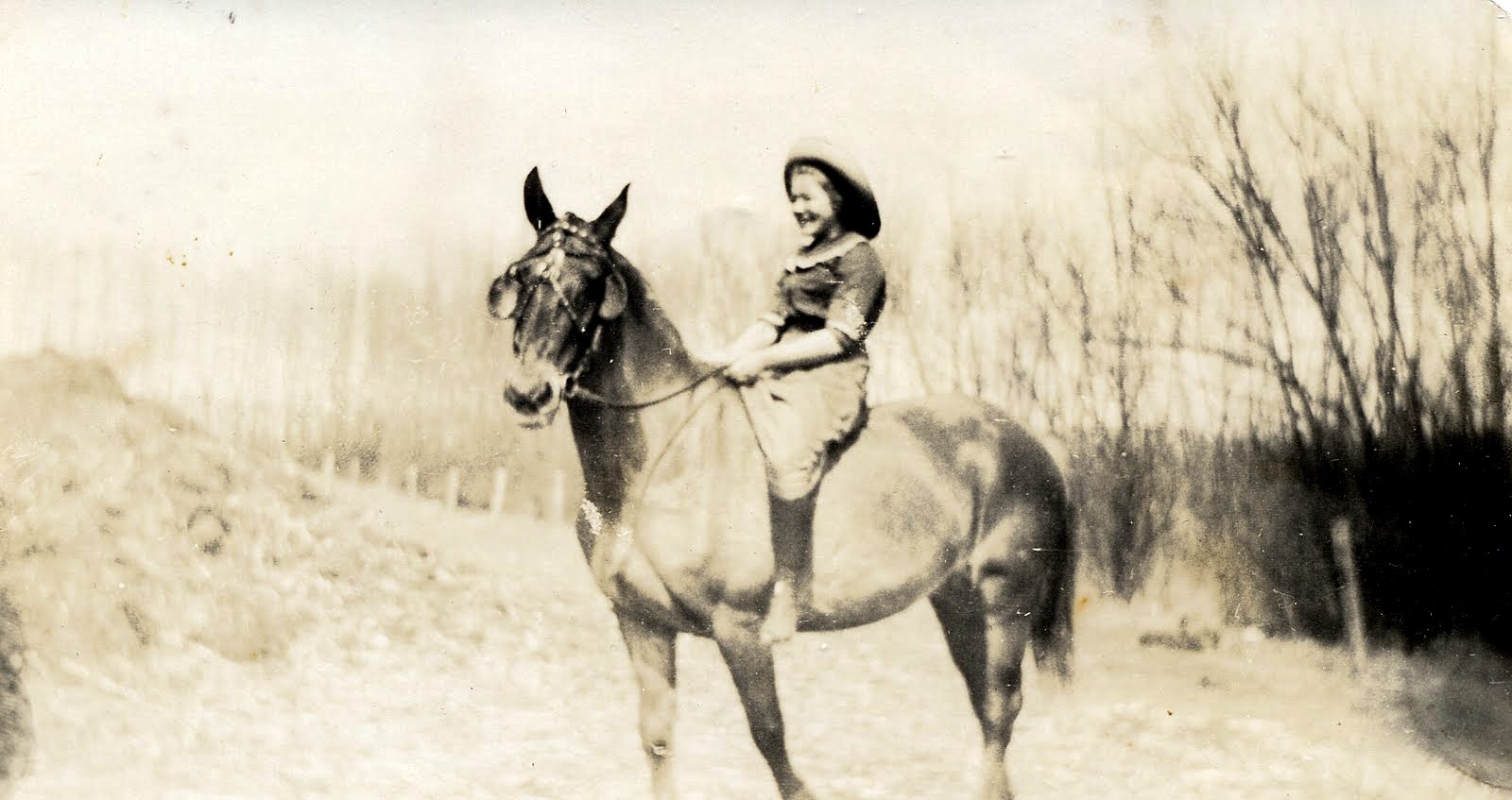
Mabel Johnson out riding.  Fosston, Minnesota, ca. 1912.
The long drive from the Bay Area to Salem, Oregon only made our visits with the relatives even more special for me.  We made sure to stop and see each relative from the home base of my aunt Phyllis's house.  This included my grandfather and all of his Oregon-residing siblings, plus some cousins.  My parents, sister and I were so stuffed from doughnuts, cookies, sandwiches, pasta or jello salads (and endless cups of coffee for the elders), we thought we'd never make through the day.  From those summer vacations of decades ago, I have lasting memories of my great aunts and the way they lived, laughed, and coped.  They turned the other cheek at any sign of trouble, and never let on if they felt nervous or afraid.  As capable as their pioneering parents and the Norwegian farmers before them, my great aunts lived each day as if tomorrow could not phase them... whatever the weather.