Thursday, August 29, 2013

Lars O. Skrefsrud: Norwegian Santal Missionary


Who is the mystery man in Great Grandma's old photo album?


As with many photograph collections bequeathed to descendants, the happy (or hapless) recipient can become dismayed by a lack of proper dating and other identification on such family treasures.  Our past family members knew the full names, addresses, and daily habits of everyone represented in the images they so carefully collected and displayed.  Why would it occur to them--those common sense farmers and homesteaders--that someone a hundred or more years in the future would be tearing their hair out, trying to piece together the relationships and everyday details of their lives?  What a silly notion!  Yet, nearly every genealogist has had the experience of caring enough to suffer that very frustration.

That is exactly the way I felt when I ran across two of the many unidentified photographs in the Victorian-era cabinet card album owned by my great grandparents, Ole and Malla (Larson) Johnson of Leonard, Minnesota.  The two photos shown below did not fit the overall theme of family and friends.  For one thing, they were a bit too formal looking.  For another, the persons bore no family resemblance, at least that I could tell.


Photo A
 Lars O. Skrefsrud (1840-1910)
The signature in the lower right-hand corner was
 undecipherable without addition information.
Photo is dated 1894/95.


Photo B
Lars and Anna Skrefsrud, foreground, with
Rev. Hans Peter Børresen (1825-1901).
Photo is dated 1894/95. 


Links to photos A and B, along with the rest of my great grandparents' album, were posted on this blog in the hope that relatives might be able to help identify them.  Soon after, I heard from a cousin, Kristie Formolo of Wisconsin, who said, "The good news is that I have lucked into identifying two of the photos from your red Johnson/Larson photo album!  The bad news is... now you have another mystery to solve!"

Kristie collects vintage "dog and people" photographs and spotted a copy of cabinet card Photo B on eBay.  She purchased it, thinking that the unidentified photo was interesting, but before she received it in the mail she recognized it as identical to one she had seen in my Johnson/Larson Picasa Web album.  At first, she was shocked that I might be auctioning off old family photos.  But, she said she came to her senses quickly and realized I would never do that evil deed.  Instead, there was a second copy, and perhaps more, of this unidentified Johnson/Larson album photo floating around.  She immediately e-mailed the eBay seller; the reply came that the photo was acquired somewhere in southwestern Wisconsin, but no further information was available.  My great grandparents, Ole and Malla Johnson, lived in northwestern Minnesota:  close, but not the exact same location.  The plot thickens!

Some time later, Cousin Kristie was again searching for the same type of collectible photo:
And now here comes the best part... A couple of weeks ago, I was once again looking for dog photos on eBay and Lo and Behold, the same exact dog and people cabinet card photo was listed...  ...The two gentlemen, and you are going to love this... they are not only identified, but they are actually quite famous!  One is a Dane and one is a Norwegian and together they founded the Santal Mission in India.

The identities of the two men were, therefore, confirmed as:  a Norwegian missionary, Lars Olsen Skrefsrud, and a Danish reverend by the name of Hans Peter Børresen.  Kristie's remaining question after her initial discovery was:  if the two men were living in India, what were they doing in Minnesota during the mid-1890s?  Both photos A and B were taken by a photographer Elias G. E. Dorge, who operated a studio at 1819 Riverside Avenue in Minneapolis from 1891-1914.  Now, that's quite a long way from India.  But, I'm happy to say I have solved the second part of the mystery, now that Cousin Kristie has solved the critical part concerning their identities.

Lars O. Skrefsrud was a renowned speaker and highly respected religious leader, especially during the 1890s.  N. N. Rønning, who wrote about Skrefsrud in a biography published by the Santal Mission in America, summarized that the respect was earned because he "went forth from poverty and prison and became one of the great missionaries of modern times."
He was a dynamic personality and powerful preacher.  'When [Skrefsrud] arose to speak, the land shook,' said a Santal elder.  'He was reared in the land of rocks and made a great contribution to Norway's shining saga at home and abroad,' wrote a Danish pastor.  'When he spoke, minutes sped as seconds, hours grew too brief; the fire in his eyes and the burning enthusiasm in his words captivated all who heard him,' declared a Norwegian educator.

Skrefsrud was born in 1840 in the parish of Faaberg, Gudbrandsdalen, one of the most picturesque areas of Norway.  His father is said to have been a man of initiative who was a skilled carpenter, blacksmith, and house builder.  His mother was a devout woman who often worried about her gifted, but "strong-willed and impulsive" son, Lars.  Despite his upbringing in a stable family environment and religious training as a youth, Skresfrud was swayed toward bad behavior after beginning an apprenticeship in Lillehammer as a coppersmith at about age 14.  After progressing from heavy drinking to burglary along with other young men, he was eventually arrested.  He spent one year under arrest, and was then sentenced to four years hard labor in an Oslo penitentiary.  Filled with true remorse, Skrefsrud experienced a religious epiphany while in prison.  His renewed faith gave him joy and motivation, but it also resulted in great happiness for a "devout and courageous" farm girl from Faaberg named Anna Onsum, who served as Skrefsrud's penpal while he was incarcerated.  Anna would later become his wife.  
 
Having devoted himself to God, Lars O. Skrefsrud immersed himself in preparation to serve as a missionary.  Prison officials supplied him with books and he began to study English and German, and memorized the entire New Testament.  When he was released from prison, he worked at a mechanical factory in Oslo, and bought Greek, Hebrew, and Latin grammar books with some of his first earnings.  The road toward becoming a missionary was challenging, for Skrefsrud first had to prove his earnestness and abilities to the Norwegian Mission Society.  For an ex-convict, this was not easy.  He was eventually sent to missionary school in Berlin, where he formed an affiliation with Danish-born Reverend Hans Peter Børresen, who became like a father to him.

After missionary school, Skrefsrud traveled to India, where he became interested in Santalistan, a district 160 miles northwest of Calcutta.  Skrefsrud's wife and the Børresens later joined him.  They secured possession of some land from the Rajah, and in September 1867, the missionaries began building huts of branches and leaves.  Børresen described the situation:  "Our neighbors," he said, "were tigers, bears, elephants, wildcats, and hyenas; our common household was composed of rats, snakes, and innumerable insects which visited us every night."  

View an image of Skrefsrud's house at the Santal Mission on DPLA
 (Digital Public Library of America).

During the years that Skrefsrud served as a missionary in India, phenomenal progress was seen. When he agreed to visit the Norwegians in America, his fame and reputation preceded him. Skrefsrud arrived in Minneapolis, Minnesota in the spring of 1894, and invitations from Norwegian-American congregations began to multiply.  Over a fifteen month period, he traveled almost incessantly, speaking several times a day to capacity crowds.  It was during one of these events that my great grandparents must have acquired the two photos of Skrefsrud that were kept in their photograph album.  Exactly when and where they listened to Skrefsrud speak is not known.  What is certain, is the effect Skrefsrud's speech must have had on them.

N. N. Rønning, the author of the Skrefsrud biography referenced in this article, described his own experience while seeing and hearing the Santal missionary for the first time.  He was teaching parochial school in Grafton, North Dakota, and joined many others at the local Opera House, which was filled to overflowing for the event.

On the great day people came walking or driving from all directions... When I had been told that Skrefsrud could, as it were, hold large audiences in the hollow of his hand for two hours or more and make people laugh and weep at will, foolish young university student that I was, I made up my mind that he could not 'get' me...  Well, he 'got' me.  I have never before or since been so helplessly and hopelessly under the spell of a speaker, and that from the time he uttered the first sentence.  It was not only what he said, but the way he said it and the way he looked which had such compelling power.


Lars O. Skrefsrud returned to India and his missionary duties on September 25, 1895.  He died in 1910, after 47 years in India.  Upon his death, friends and acquaintances remarked:  "Skrefsrud was one of the most remarkable men in the Norwegian Lutheran Church.  By nature he was endowed with tremendous power and glowing enthusiasm..."  Also, "Skrefsrud was a powerful personality, cast in the mold of the Viking chiefs of old."  His legacy, as understood by common Norwegian Americans like my great grandparents, was a simple but powerful one:  he was a man whose outstanding characteristic was as a "sinner saved by grace."  Aside from Skrefsrud's great charisma and powerful speeches, it was more than enough to inspire a generation of Norwegian American Christians. 


Sources:

--Minnesota Directory of Photographers:  http://www.mnhs.org/people/photographers/
--N. N. RønningLars O. Skrefsrud: An Apostle to the Santals (Minneapolis, Minnesota:  The Santal Mission in America), 1940.

Friday, August 23, 2013

O Canada! Like a Close Cousin

As an American descended from Norwegian and Celtic ancestors, I can't help but feel a close affiliation with, and longing for, certain other countries like Norway, Scotland, and Ireland.  Though I personally identify more with my mother's Norwegian family heritage, the sound of bagpipes combined with a flash of tartan never fails to stir my soul.  But, also vying for position near the top of the list is a country a little closer to home---a distance of only 75 miles to the border, in fact:

 Canada


My mother has always maintained that she is 100% Norwegian-American, but admits she might have just enough Swedish genes to lay claim to the area taken up by one little toe.  Perhaps it is the same with me and my various links to Canada, but in this case, the claim is also made on emotional territory.

My adopted father was a native Canadian.  Dad was born in Vancouver, British Columbia to an ex-patriot American father and a Scottish-born mother.  His mother died when he was five years old, and his father died a few years after that, so he spent the majority of his childhood in a Vancouver orphanage and foster homes.  When he became an American citizen in the mid-1940s, Dad left behind the graves of his parents and three siblings in Vancouver.  He moved to California where his sister lived, but a second sister had been adopted out to an unknown Vancouver family soon after her birth.  Happily, Dad was able to make contact with the unknown sibling a few years before his death.  In 1973, he made a trip back to Vancouver to meet his little sister for the first time, and also visited some beloved family friends and locations important to him as a child in Canada.

Since I am Norwegian-American on my mother's side, then I surely also have Viking blood ("Oh, so that's where all the tenacity comes from," I can hear some smirking!).  Vikings arrived on the shores of Newfoundland (Canada), over 1,000 years ago, looking for new trade goods.  They left the ruins of their Icelandic-style dwellings to be discovered centuries later.  You can read more about the first European discovery of North America on the Smithsonian Institutes's Natural History Museum website:  Vikings, the North Atlantic Saga.  Hmmm... if the Vikings were the first Europeans to set foot on North American soil, then why is Columbus Day (October 12) more prominently celebrated than Leif Erikson Day (October 9)?  Perhaps it is some consolation to Scandinavian Americans that Leif Erikson Day comes before Columbus Day on the calendar.

Canada also served as the point of arrival in North America for the majority of my more recent Norwegian ancestors.  During the 1850s and 1860s, many immigrants coming to America, especially from Ireland and Norway, arrived on sailing ships at a detention station at Grosse Île, an island near Quebec.  From there, my great great grandparents and their families made their way by land to locations within the United States.  You can access surviving records online from the quarantine station at the Library and Archives Canada site for Immigrants from Grosse Île.

If my Norwegian ancestors had not formed prior plans to meet up with friends or relatives in Wisconsin and Minnesota, they might have been tempted by the wild beauty of Canada.  Some men in the family later revisited the idea of settlement there.  A few years ago, I connected with an entire branch of the Winje family that was descended from Edward Winje, who left Minnesota for farming in the open fields of Saskatchewan and later moved with his son to British Columbia.  I have many Canadian cousins from that Winje line, and I know the British Columbia residents are proud, and rightfully so, of their beautiful province.


For twenty years, my husband and I regularly spent Week 50 at a timeshare in Whistler, British Columbia.  The objective was to enjoy the unparalleled scenery from the ski slopes of Whistler/Blackcomb, as well as the ambiance of its international village.  We could not help but notice the level-headed friendliness of Canadians who crossed our paths.  We also watched their government in action and marveled at how it did not waste any time as far as preparing for the 2010 Olympics was concerned.  Stretching from North Vancouver to Whistler, B.C. is the stunning ribbon of a coastal road romantically named the Sea to Sky Highway.  It was evident that the Highway 99 corridor, often narrow and sometimes treacherous, needed to be widened in some areas to safely accommodate the increased traffic expected for the Winter Olympics. The year after the contract for the 2010 Olympics was secured, we were surprised to see the roadside blasting had already begun, with 9 years left to go before the deadline!  Now, that is being proactive, and the sight won my respect for the Canadian powers-that-be for their ability to expedite the inevitable infrastructure repair in such a manner.  No one was going to catch the Canadians asleep at the wheel when the world came to visit, no sir!  

I'm not the only one who has a warm and fuzzy feeling for our hefty and well-mannered neighbor to the north.  It turns out that Canada is at the top of the international popularity list for the third year in a row.  In June, Forbes published its annual list:  The World's Most Reputable Countries, 2013.  Thousands of consumers from G8 countries were asked to rate nations based on four things:  overall reputation, good feelings about the country, whether it was admired and respected, and last but not least, trustworthiness.  I'm happy to say that Norway (this is a Norwegian genealogy blog, after all) also made the top section of the list, coming in at #5 after Canada, Sweden, Switzerland, and Australia.  A reality check is that the United States currently rates #22.  Come on, America... we can do better than that!  Let's roll up our sleeves and get some good old team spirit in action.  A little spit and polish never hurts, either.  We are not a nation of quitters!  Okay, enough cheer leading.


The United States will always be my home, but Canada will always have a little piece of my heart. In addition to the personal reasons I have already described, Canada has value because although it is the second biggest country in the world, it has less population than the top 30 of countries worldwide, therefore, it has a lot of wide open space.  Canada also has more coastline than any other country, plus a diverse geography with many mountains, lakes, and waterways that brings tourists from near and far.   Based on the evidence, the attraction is understandable, eh?

Wednesday, August 07, 2013

Wordless Wednesday


A little doll from the past!

An unidentified photo (taken in St. Peter, Minnesota, ca. 1900) from the Victorian cabinet card album of Erik and Karen (Larson) Stallen Pedersen of Grand Forks, North Dakota.

Wednesday, June 19, 2013

Wordless Wednesday

One of my favorite pics of Mom and Boo (my little sister), taken at a family
 wedding anniversary celebration in Pleasant Hill, California; Sept. 1962.
(Photographer:  Elmer Lynn "Buzz" Wheeler)

Saturday, June 01, 2013

A Year in the Life of Nordic Blue


Taking the lows with the highs

My prettiest dress ever, a neat ponytail,
 and a party to attend on a sunny day.
Richmond, California, 1959.

All too soon after...

...As a patient in Alta Bates Hospital (Berkeley, California),
 with a case of the croup.  After a scary ride to the hospital it was
 pretty lonely inside my oxygen tent the first night, and I was
 much happier when my parents came back to visit the next day.
 Of course, new toys didn't hurt, either.

Friday, May 17, 2013

A Cure For What Ails You: Ole B. Berge

Anne Marie (Slaeen/Sloan) and Ole B. Berge,
 Dec. 1945.
One of my maternal great grandfathers was the ultimate grandpa, so I'm told.  Ole Benhardt Berge was a stately, "beautiful" man, according to another one of his great-grandchildren who knew him personally.  Ole had a full head of hair even when elderly, which had gone totally silver from the dark hair of his youth, and a full moustache that was the envy of many.  He was an honorable man all of his life, right up until the day he died.  But, even the most honorable of men can still encounter little blips and challenges along the pathway of life.

Ole B. Berge left the picturesque Gudbrandsdalen Valley near Lillehammer, Norway in 1869 at the age of four, along with his mother, Karen Bue Berge, and older sister, Othilie. Ole's father, Gulbran Olsen Berge, left Norway a year before his wife and children; he was a passenger aboard the Hannah Parr during the eventful Spring 1868 voyage that ended up being one of the best documented excursions of early immigrant sailing vessels.  Karen could not travel until the next year because she was expecting a baby, a little girl who died shortly after birth.  Four more children were born in America, including two daughters who survived childhood:  Gunda and Sophie.

During the early years of his married life, Ole B. Berge farmed west of Maynard in Chippewa County, Minnesota.  In 1896, he moved his family into town where he built the first hotel. A few years later, he operated the town's first meat market with George Lawrence, and also worked as a postal carrier. The Berges then moved to Leonard, Minnesota in 1910, but they were not able to make enough living from their Leonard area farm, so they returned to Maynard after seven years and Ole again took an interest in civic affairs and was engaged in many activities.

Ole was a gentle, well-respected, and somewhat quiet man, but he did have a couple of vices.  For one thing, he smoked a pipe, which was not uncommon among Norwegian men.  When he was a young boy, his mother arranged for a photograph to be taken of her "little man" in Norway before boarding their ship for America in 1869.  Ole was posed with a miniature pipe in his mouth, meant to look just like Papa Gulbran's, I'm sure.

Ole B. Berge, 1869
In addition to his pipe, Ole was also rather fond of whiskey.  Perhaps it helped him deal with day-to-day stresses, since he did not have the kind of personality that would have allowed him to deal with things head-on.  In October 1897, at age 32, he admitted himself to a rehabilitation clinic in Minneapolis.

Although Ole enjoyed a bit of whiskey on a regular basis, family members have indicated that his drinking was moderated and did not appear to be problematic.  His wife, Anne Marie ("Mary") may have been concerned that he was drinking at all, and he obviously did not want to give her cause to worry.  Mary, as she was called, was known to be a sweet woman and loving companion.  Both she and Ole were active in the Lutheran Church.  In 1897, she and Ole were raising five young children in Maynard, Minnesota:  George, Harry, Chester and Esther (fraternal twins), and Mabel, who was a year old.  They had lost a child, the first Chester Albin Berge, in 1892.  In the following years, Mary would give birth to six more children:  Bennie, Cora, Mildred, Clarice, and Stella, and the last child, who died as an infant in 1911.  Esther, one of the fraternal twins, was my maternal grandmother.

The "Gay Nineties" brought an epidemic of alcoholism that swept across America, and Dr. Leslie E. Keeley's "cure" caught the wave on the rise.  The Keeley Institute utilized a special double chloride of gold remedy for "Liquor, Opium and Tobacco Habits, and Nerve Exhaustion."  Professor H. Wayne Morgan in his book, Drugs in America, concluded that "whatever the precise nature of the compounds, they clearly relied on tranquilization and antagonism for effect. Some relaxed and stupefied the patient while others created a temporary distaste for alcohol ... As for gold, its presence, if any, was hard to detect, and it had no therapeutic value, but had strong symbolic appeal."

Letterhead from the Keeley Institute in Minneapolis, from a letter written by Ole B. Berge to his wife, Anne Marie on October 4, 1897.

I have copies of three letters that Ole wrote to his wife, Anne Marie ("Mari"), during his stay at the clinic in October 1897.  They need to be translated from Norwegian into English before it can be determined whether any of Ole's feelings on the matter are revealed in his writings.  All that is known currently is that, after going through the program for several weeks, Ole returned home and apparently picked up his old habit where he left off.

During the Berges' second round of residence in Maynard, they lived in a house on the eastern edge of town, which Ole built himself. A great-grandson, Curtis Leroy Berge, said that Ole and Mary usually kept barrels of lutefisk in the second story of their home and that they seemed to live on the stuff during the winter. Curtis remembered going to Maynard on the train to visit the Berges when he was a boy. His Great Aunt Clarice would meet him at the train station and walk back with him to the house. In addition to the ever-present lutefisk, Great Grandma Mari and the young aunts were continously "baking up a storm."

At age 68, Ole suffered a stroke from which he never fully recovered.  Even so, Ole and his wife, Mari, celebrated their 60th wedding anniversary before her death in 1947.  Despite Ole's moderate dependency on whiskey throughout most of his adult life, he lived to the good age of 84, passing away on January 24, 1949.  Ole and Mari are buried beside one another at Maynard Lutheran Cemetery in Chippewa County, Minnesota, near their home for many years.


Sources:

--Berge, Ole B., Obituary:  newspaper clipping from Chippewa County, Minnesota, Jan. 1949, copy in the possession of the author.
--Groothuis, Michael J.  Voice From the Past (Chinhinta Productions, 1987).
--"In the 1890s, alcoholics lined up for the Keeley gold cure." (http://www.blairhistory.com/archive/keeley_cure/OWH_story.htm), accessed 5/11/2013.
--Minnesota Death Index, 1908-2002.
--Morgan, H. Wayne.  Drugs in America:  a social history, 1800-1980 (Syracuse:  Syracuse University Press, 1981).

Monday, April 22, 2013

Thank You, Family Tree Magazine!


Nordic Blue had the honor of being chosen among the Top 40 Genealogy Blogs in 2013 by Family Tree magazine.  I must say, this caught me by surprise, because there are so many deserving genealogy blogs out there.

"Family history how-tos, hints and humor abound in our picks for the top 40 genealogy blogs of 2013."  The categories included:  good advice, tech support, gravestone matters, shop talk, story time, and the area Nordic Blue was selected for--heritage help.  Congratulations to all of the chosen blogs, and to those who were not selected this year, but are equally deserving, keep looking forward.  We appreciate you!

Friday, March 22, 2013

A Tribute to Great Aunties: The Johnson Sisters


Mabel Johnson, Thea (Johnson) Humberstad, and Cora (Johnson) Moen.  Richmond, California, November 6, 1946.

At times, I have a longing to hear the Norwegian-American brogues of my great aunties again. These women, who have been gone for many years now, were especially important to me as a child, since I did not experience the love and indulgences of a grandmother while growing up.  My maternal grandmother died of tuberculosis when Mom was not yet two years of age, and my adoptive father was orphaned while still young.

My great aunts were among ten children born to Ole and Malla Johnson, who were both of Norwegian-American immigrant families.  The Johnsons began their married life in Chippewa County, Minnesota, and then moved to in Fosston in Polk County, and spent the last decades of their lives farming near Leonard in Clearwater County, where my mother was raised.  The ten children were:  Bennett, Ernest (my grandfather), Cora, Thea, Odin, Mabel, Oral, Ruben, Carl, and Frank.  All lived to a ripe old age;  I'd say that was quite an accomplishment for young parents starting a family in the late 19th century.

One of my cousins jokingly refers to the photograph of the middle-aged Johnson sisters in their winter coats as "The Three Stooges."  I had to laugh the first time I heard that, because there does seem to be something reminiscent of the mock severity of a Moe, Larry, and Curly portrait in their demeanor.  But, perhaps the joke is on us, because both my cousin and I are now older than our great aunts at the time their photograph was taken. How time changes one's perspective!  But, no one can deny that they were once the sweetest little babies, as cute as a mother could ever hope for...

Cora and Thea Johnson, ca. 1893.


Cropped image of Mabel Johnson, ca. 1899.  Granite Falls, MN.

Thea was the first to leave her home state of Minnesota for Oregon, where her husband, Carl Humberstad, a lumberjack, saw job prospects with the prolific west coast lumber business. Cora and her husband, Emil Moen, followed to Oregon soon after. Mabel, who never married, left her job at a hotel laundry in St. Paul, Minnesota, to ride west on the train with my mother, Doris Johnson, in 1945. The pair were following my grandfather, Ernest Johnson, and my aunt, Phyllis Johnson, to Richmond in the San Francisco Bay Area.  Mabel rented an apartment in a Richmond four-plex until she retired in the early 1960s and then moved to Salem, Oregon, to be near her sisters again. After that, it was necessary for my family to go on vacation in order to see nearly everyone in my mother's family, especially after Grampa Ernest moved to Salem, as well.


Cora Johnson Moen:  born July 15, 1891 in Montevideo, Minnesota; died May 28, 1975 in Salem, Oregon.


Cora, the eldest Johnson sister, lived with her son and daughter-in-law in a house that backed up to my Aunt Phyllis's house in Salem.  Cora was my mother's favorite aunt, because she was the most maternal to my mother when she was a girl.  To some, Cora seemed a little too serious, and too much of a disciplinarian.  But, her "no-nonsense" attitude was formed by necessity as the eldest daughter on her parents' farm.  Expectations on her were high, and she was required to take on a heady round of day-to-day responsibilities up until the time she left home as a married woman.  Cora and her husband, Emil, had only one child, Harvey, and she was devoted to both of the men in her life.  Cora had the great misfortune of suffering the loss of both her parents and her husband in the same year, 1948.  In about 1960, she bought a new ranch-style house in Salem, and apparently gave her previous home to her sister, Mabel.  The new home had a large brick fireplace with built-in shelves on either side, all filled with good-sized animal ceramics that she collected.


Cora with her husband, Emil Moen, and their son, Harvey.  Clearwater County, Minnesota, ca. 1930.


Thea Johnson Humberstad; born April 28, 1893 in Montevideo, Minnesota; died February 6, 1967 in Salem, Oregon.


Thea, the next eldest sister, caught people's attention not only because of her short, round stature, but also because of her jolly nature and light-hearted, tittering laugh.  Thea possessed plenty of farm girl sensibility, but it was coated by an overall good sense of humor.  She and her husband, Carl Humberstad, were well-loved by many.  Thea gave birth to two sons:  Curtis, born in 1925, who died four days after birth, and Wesley, born in 1927.  The Humberstads owned a small white house with pink trim in West Salem, and they filled the yard with flowers and whimsical wooden yard ornaments made by Carl--everything from sunbonnet girls and painted tulips, to bird and duck whirly-gigs, and a windmill, of course.  Inside the house, nearly one wall of their tiny living room was filled with a salt and pepper shaker collection that would have been the envy of any antique dealer.  An old spinning wheel, brought from Norway by Carl's mother, took up another prominent corner of the room.  Not one to enjoy anything without a bit of whimsy added for spice, Carl painted his mother's old constant friend a bright shade of peppermint pink.  Thea was the first of her siblings to pass away, in 1967.


Thea (Johnson) Humberstad standing on the porch of her
 West Salem house, early 1960s.


Mabel Johnson:  born February 10. 1898 in Montevideo, Minnesota; died July 23, 1983 in Salem, Oregon.


Mabel, the youngest sister, was never married.  My grandfather thought this sister of his was a little too silly at times, even though she did work hard as a youngster in addition to seeking out friends and fun.  Mabel had to do all of the baking on the farm after her older sisters married, and became responsible for sewing all the clothes needed for her young nieces, Phyllis and Doris.  In late summers, she often traveled to South Dakota to serve as cook for threshing crews.  I felt particularly close to Mabel, because we lived with her when I was a baby, and she occasionally babysat for me in the years to follow.  I liked nothing better than to revisit her old apartment overlooking the railroad tracks in Richmond, and then later, her little bungalow in Salem, which had probably been given to her by her sister, Cora.  She was the only adult I knew who would play endless rounds of "Go Fish" or "Old Maid," and she preferred to distract kids from arguing by using a metal clicker, like in dog training.  After Mable moved to Salem, her only income was Social Security and a little babysitting money.  She was very frugal--buying only at second-hand stores, going without a telephone or garbage service (her brothers carted it away), and retiring for the evening whenever it got dark, in order to avoid using electricity as much as possible.  At her house in Salem, she usually had a dog to keep her company.


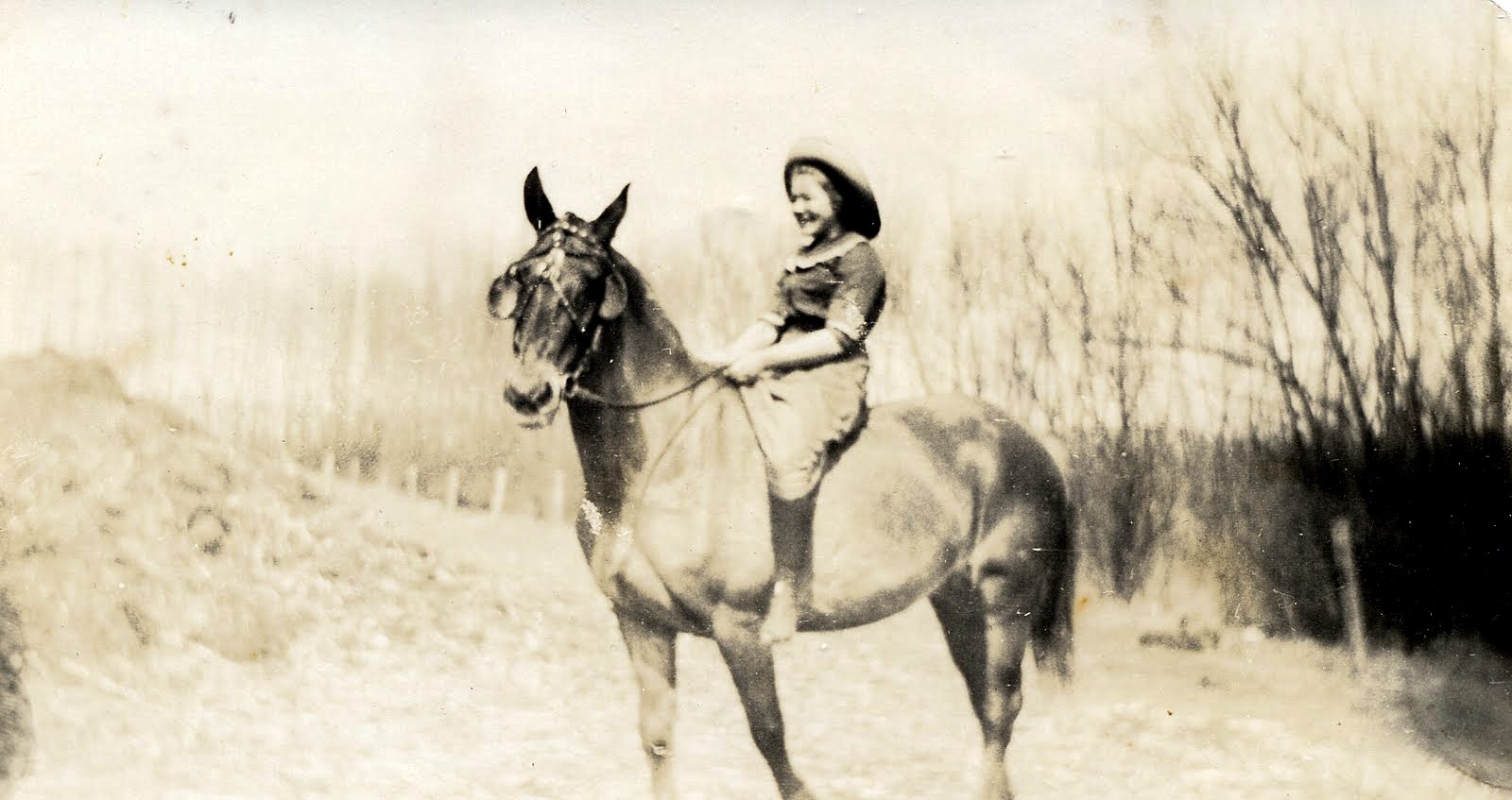
Mabel Johnson out riding.  Fosston, Minnesota, ca. 1912.
The long drive from the Bay Area to Salem, Oregon only made our visits with the relatives even more special for me.  We made sure to stop and see each relative from the home base of my aunt Phyllis's house.  This included my grandfather and all of his Oregon-residing siblings, plus some cousins.  My parents, sister and I were so stuffed from doughnuts, cookies, sandwiches, pasta or jello salads (and endless cups of coffee for the elders), we thought we'd never make through the day.  From those summer vacations of decades ago, I have lasting memories of my great aunts and the way they lived, laughed, and coped.  They turned the other cheek at any sign of trouble, and never let on if they felt nervous or afraid.  As capable as their pioneering parents and the Norwegian farmers before them, my great aunts lived each day as if tomorrow could not phase them... whatever the weather. 

Sunday, March 17, 2013

Happy Birthday to Mom!


Bill and Doris Wheeler as newlyweds in 1954

This photo was taken shortly after my parents were married, on the steps of the duplex they shared in Berkeley, California for a few months before purchasing their own house.  Today, Mom is celebrating her 93rd birthday, and I would like to share this poem in her honor.


A Prayer for a Mother's Birthday

by Henry Van Dyke


Lord Jesus, Thou hast known
A mother's love and tender care:
And Thou wilt hear, while for my own
Mother most dear I make this birthday prayer.

Protect her life, I pray,
Who gave the gift of life to me;
And may she know, from day to day,
The deepening glow of Life that comes from Thee.

As once upon her breast
Fearless and well content I lay,
So let her heart, on Thee at rest,
Feel fears depart and troubles fade away.

Her every wish fulfill;
And even if Thou must refuse
In anything, let Thy wise will
A comfort bring such as kind mothers use.

Ah, hold her by the hand,
As once her hand held mine;
And though she may not understand
Life's winding way, lead her in peace divine.
I cannot pay my debt
For all the love that she has given;
But Thou, love's Lord, wilt not forget
Her due reward,--bless her in earth and heaven.      

Sunday, March 10, 2013

Peek-A-Boo, Malla, We Found You

Malla Larson, at about age 16,
 ca. 1884 (this is the earliest
known photo of my great
 grandmother). 
Every family historian knows how maddening it can be when a source cannot be found to prove data that is well known by the family.  Some people call that a "brick wall," but you could also call it just plain frustrating.  Several family historians approached the problem of finding a birth or baptism date for my maternal great grandmother at different times, with no "proof" found other than what was written in the family Bible.

Malla (Vigesaa) (Larson) Johnson always told her family that she was born in LaCrosse, Wisconsin on April 20, 1868.  One thing I soon realized about my Norwegians ancestors is that they assumed major landmarks would stick in people's heads better than too much detail.  So, rather than specifically identifying where she had been born, Malla simply referred to nearby LaCrosse.  The trouble is, no birth or baptism record was forthcoming using the standard searches.

It was apparent that we had to go right to early church records, if any existed. Through collaboration with a cousin-in-law who is writing a Larson family history, it was determined that Malla must have grown up in Coon Valley, Wisconsin, a stopping-off place for many early Norwegian immigrants.   We had found proof of other family members living there, but nothing about Malla relating to Coon Valley.  She was still a child when the Erik and Kjersten Larson family relocated to Chippewa County, Minnesota and began homesteading.  We also knew that the family would not have attended any church other than Lutheran, which narrowed down the possible records.

It turns out that records for the Upper Coon Valley Lutheran Church in Wisconsin are only available in one place:  the LaCrosse Public Library.  I knew that if we were going to find anything on Malla's birth data, it would probably be on microfilm from that library.  Unhappily, I could not access the microfilm via interlibrary loan, so I began calculating how many years it might take before I could personally visit LaCrosse.  Too many, it seemed.

If we are patient enough, sometimes good things have a way of just happening (continual networking doesn't hurt, either).  I was just now contacted by a cousin-in-law, Nancy Larson, who has been working on a family history of our branch of the Larsons.  She made a new internet contact about whom she said, "It turns out she lives in Wisconsin. Turns out she works at a genealogy library, specializing in Norwegian research."  My cousin's new contact, after accessing the church records of interest on microfilm owned by the ELCA Archives (Evangelical Lutheran Church of America), came up with the following information:

#19 - Molla (Malla) b. 20 April, 1868, bap. 22 May, daughter of Erick Larsen and Christine Olsdatter, witnesses Sven Pederson, Engebret Sinbakken, Anne Jensdatter, Johanne Bredesdatter

Source:  ELCA Film #29 Upper Coon Valley 1868 Baptisms 1868

Ah!  Our search for Malla Vigesaa Larson's proof of birth has ended, with special thanks to a sympathetic professional and fellow researcher somewhere in Wisconsin.  I guess my trip to LaCrosse can wait a little bit longer...

If you are having a difficult time finding data for any Lutheran-American ancestors, try the research information and services available at the ECLA Archives, as specified on their webpage regarding Genealogy and Microfilm.  When doing family history research, ECLA Archives staff recommend first checking census records, naturalization papers, city directories, or related sources, before considering congregational records, especially if you are not certain your relatives were Lutheran.

Friday, March 08, 2013

My Childhood Home: Then & Now


Oh, the places the internet can take you now.  It has been 12 years since I last visited the San Francisco Bay Area and drove by the house where I spent most of my childhood on Carlson Boulevard, in the Panhandle Annex of Richmond, California. I discovered that I need not drive all the way to California to see what's up in the old 'hood, however.  We can fly nearly anywhere via Google Maps and look down upon fields, yards, and rooftops, and engage in innocent voyeurism from afar much like a pedestrian taking an early morning stroll.  If these techniques do not offer enough input, then online real estate listings will provide the rest, including photographs of exteriors, and even interiors whenever properties go up for sale.  But, in these photos our old stomping grounds can often be unrecognizable due to removed walls, added windows and structures, completely updated kitchens, and the like.  One thing I did recognize in a current photograph of the exterior of my childhood home was a black lava boulder that became a fixture at the bottom of our walkway.  It is still there today... but, more about that in a bit.


View Larger Map

The Richmond Panhandle Annex is the neighborhood shaded in blue.

My mother was raised on a Minnesota farm, and as a young adult, she worked seasonally at Richmond canneries.  She knew how to save money on a low income, so she was able to provide the down payment on our bungalow after she married Dad.  Our first house could not have been more than 1,000 square feet, with a living room, two small bedrooms, one bath, a kitchen that looked out onto the backyard, and a dining room.  Off the dining room there was a laundry room that connected to the one-car garage, and hiding underneath the laundry room was a small concrete cellar, intended as a air-raid shelter.  The house was built along the west coast during the threat of U. S. involvement in World War II (1940), and the architect seems to have taken family security quite seriously.  The cellar was accessed by lifting up an angled double-door, which sat against the back of the house much like an old-fashioned tornado shelter.  When Mom later had a family room built along that exterior back wall, a trap door in the laundry room floor became the only access.  A sump pump was installed in the cellar floor to deal with the constant moisture problem, courtesy of San Francisco Bay.  We always did battle mildew in that house.

Our lot was 7,500 square feet, bordered to the north by another single-family bungalow, and to the south by a two-story tri-plex apartment building.  Like most homes, the garage served us well for storage, and Dad's Ford fit nicely in the driveway.  The house was white with red shutters and a painted red porch and walkway, and it remained that way for many years.


Dad (Bill Wheeler) and me, with my favorite doll, Jane,  in front of the original shed at the back of the Carlson Blvd. house in April 1955.  We moved to the house that spring from a duplex apartment shared with Dad's cousin.

Growing up in the house on Carlson Boulevard meant a series of small things to me as a child.  Before my sister was born, and just after, I was regularly encouraged to play by myself in the backyard.  This meant regular visits with our beagle, who lived near the chicken coop and rabbit cage beside the shed.  The original shed that came with the house was later torn down and rebuilt by Dad and my maternal grandfather, Ernest Johnson.  The new shed was painted barn red to match the shutters on the house.  In addition to watching our animals, I spent my leisure time "popping" snapdragon flowers whenever Mom was not looking, climbing the wood fence to study the passion flowers growing over the neighbor's arbor, making cities out of baby powder cans and bottles on the lawn for my toy cars, or just laying on my back studying cloud formations.  When I was a little older and Mom was willing to trust me with the shed key, I sometimes took solitary sojourns to look at Dad's tools, even though I did not get to learn how to use many of them.  Still, I managed to pound more than a few nails into blocks of wood during those years, and came away with greasy enough hands that my shed adventures seemed satisfying enough.


The Wheeler home on Carlson Boulevard in Richmond, California, ca. 1956.

The essence of any family life, of course, is what goes on within four walls during the many hours of togetherness.  On Carlson Boulevard, my routine pretty much centered around a strict bedtime, and usually a breakfast of toast, jam and milk, the standard peanut butter or bologna sandwich for lunch with fruit and cookies, and whatever we had on hand for dinner: meatloaf, lamb or pork chops with potatoes, and (yuck) canned vegetables.  Whenever we had ham, it was the pre-cooked breakfast type that Mom would then fry to smithereens in a cast iron skillet.  Food was just sustenance, and she did what she could with the bargain groceries Dad sought out at the local Safeway.
 
My K-6 school days involved piano lessons from Mrs. Alva Anderson once a week before school, and walking the long blocks to Alvarado Elementary along a busy four-lane boulevard and under the busy I-80 overpass. More concrete awaited me at school, which was built atop a slope with a small play yard on the same level as the single story school building, and two large play yards cascading below.  Each level was separated by mountainous concrete embankments, with not a tree or a patch of dirt on the grounds, except for the small lawn at the office entrance. 

There are also sensual memories that linger from Carlson Boulevard, like listening to the mournful Alcatraz Island fog horn blaring from the middle of the Bay during periods of dense fog, and the tingling scent of eucalyptus trees in nearby Alvarado Park, part of the East Bay Wildcat Canyon Regional Park system.

As a new homeowner, Mom had visions of self-sufficiency like she experienced back on the farm.  There was at least one occasion when a batch of chicks was kept warm under a heat lamp on the laundry room floor, awaiting placement in the backyard chicken coop... ducklings, too, although they fared much less well than the chickens.  The poultry venture only lasted a few short years, however, until complaints from a neighbor put an end to our attempts at urban farming.  We have not been the only ones who were ever ignorant of zoning rules, however.  I had to laugh out loud in many places when I first read Farm City:  The Education of an Urban Farmer, by Novella Carpenter, which details an adventure in backyard self-sufficiency in nearby Oakland, in the midst of a more extreme urban environment than I ever experienced.

After my sister, Becky, was born,  she soon developed into a playmate with distinct preferences.  I do not remember how many hundreds of times I had to play "Mousetrap" on the living room floor or listen to the dreaded recording of "The Rooster With The Purple Head."  All for the love of family!  It was also at the house on Carlson where I watched the Beatles perform their famous stint on the Ed Sullivan Show in February 1964, and hid under the blankets at night after watching the terrifying "Creature From the Black Lagoon" on our black and white television set.  It was not my first sleepless night, however.  I never did understand why Mom made me sleep in her twin bed just after my sister was born, while she stayed with the baby in my bedroon.  Didn't she know that there were alligators living in her and Dad's closet, just waiting to slither across a darkened room and snap at stray little arms and legs?

The dark, sparkling lava boulder I mentioned earlier became a permanent part of our front yard in about 1960, though it was never intended to be. The "boulder incident" occurred during one of our annual vacations in Oregon. Each August, Dad would take his two weeks vacation from the Bell Packing plant in Emeryville and drive our 1957 Ford Ranch Wagon northward, to Salem. My mother had a fair number of relatives in the Salem area: my aunt, grandfather, great aunts and uncles, not to mention cousins. During one visit when I was about 8-10 years old, Dad took a couple of the men in the family to do some rock hounding, probably in eastern Oregon. While he was away from the others (bathroom break, perhaps), my great uncle, Frank Johnson, and a cousin, Harvey Moen, managed to displace a large volcanic rock from a nearby outcropping.  Dad returned to find a big object perched atop the station wagon, looking rather like a lighthouse optic section had sprouted on the roof.  He must have been angry, but Mom does not recall his showing more than a mild annoyance. He probably did not want to admit that he had been taken.  At 5'3" in height, Dad could not even begin to move the boulder on his own without damaging the wagon, and he never would have demanded help from the pranksters themselves.  I do not have any memory of what occurred after that, but Mom says we drove the 800 miles + back to the Bay Area with that lava rock perched atop the car. She was amazed that the Highway Patrol did not pull us over and ask about it. At home, a friend or neighbor helped lift the dense rock off the car.  Where the rock first came off the car is where it stayed, at the edge of the driveway. The boulder was so heavy that it left a crease on the roof of the Ford.


The Wheeler home on Carlson Blvd. in 1965.  Note the lava boulder at the bottom of the walkway steps, left-hand side, in front of the trailer.

  
Like most urban neighborhoods, Richmond, including the Annex, has had its ups and downs.  The City of Richmond, which borders San Francisco Bay, experienced a population explosion in the 1940s due to the shipyards and other wartime manufacturing.  But, decreasing industrial jobs after the war and the relocation of many businesses to newer areas created an economic depression, and property began losing value.  By the 1970s, the area was decaying rapidly.  As per example, other owners of the house on Carlson Boulevard had bars installed on the front door and windows at some point.  Richmond, sad to say, developed an infamous reputation based increased crime rates and gang activity over the past few decades.


The same house in 2001, some 36 years after my family moved to El Cerrito.  Bars had been installed on the front door and windows--a sign of significant change in the neighborhood. The lava boulder remains, barely visible below the door of the white pickup.

A comment was posted on Yelp:  City of Richmond by a former resident, and I could not have put it more eloquently:

This is not a review of Richmond, but a lament, really... Richmond is the best little city that could have been but never was. It has everything going for it, all the ingredients that could have made a nice town: great old architecture (what hasn't been torn down yet), cheap housing and some beautiful old houses, great location and weather. It used to be a real working man's town... Then they tore down downtown. Richmond has been the victim of poor urban planning, endemic racism (from all sides), and an inert and inept city government. Add crime, drugs and a huge population that has lost its ability to function without public assistance and it is a recipe for dysfunction...  don't get me wrong, I still like Richmond because I'm from there... Overall however, when I am there I just can't wait to get out again... One thing I have to say about growing up in Richmond is that I can definitely tell the difference between backfire and gunshot.

The good news is that the old neighborhood may be on the verge of re-surging values, both socially and economically.  Young business professionals, who are finding a shortage of affordable housing elsewhere in the Bay Area, are snapping up real estate "deals," and buying older, less expensive homes and refurbishing them to the max. The latest owners of my childhood home have not only taken off the iron bars, but the interior has been completely modernized in recent years, with a covered deck added to the backyard.  Things are now looking up again for the Panhandle Annex.  No matter what changes lie ahead for my childhood community, I will always have my memories of growing up as part of a Richmond blue collar family with strong, traditional values--a beginning as rock-solid as that lava boulder that still keeps guard along my old walkway.

Monday, February 18, 2013

"Whiskerinos" and the Golden Jubilee of Richmond, California


Ernest Johnson, age 58, dressed for the Golden
Jubilee in Richmond, California, August 1947.

I was quite surprised when I first saw this photograph of my maternal grandfather, Ernest Johnson, with a beard and moustache adorning his face. To my knowledge, he had never worn any facial hair, aside from an occasional unshaven stubble that he liked to rub against his grandchildrens' faces for their squeamish reactions.  My mother told me that when they both lived in Richmond, California, the city held a Golden Jubilee from August 22-24, 1947, to celebrate the 50th anniversary of the city's founding. Among the planned activities was a "Whiskerino" contest, for which "Richmond's male populace [had] been grooming their whiskers for weeks."  Grampa always seemed to be a team player, having been raised with nine siblings, so I'm sure he thoroughly enjoyed the anticipation of the events, and perhaps talked over plans time and time again in the break room with his fellow custodians at the Ford Plant.

In 1945, my grandfather moved to the west coast from Leonard, Minnesota, when he could no longer make an adequate living as a farmer.  By 1947, he had been a widower for over 25 years.  Richmond, California was a boom town during World War II, mostly because of the local shipyards and the tank production going on at the Ford Motor Company plant.  Housing shortages continued right after the war, so Grampa lived for a time in a boarding house and then rented a room above a water tower.  He was a modest man with simple needs, and he knew how to get those basic needs met by taking steaks or salmon from the Richmond Pier to his sister's nearby apartment on Sundays, in exchange for a good home-cooked meal.

Richmond's Golden Jubilee celebration was meant to serve as a reminder of the "good old days" in the history of the west. It seems that not just my grandfather, but many other Richmond residents had a lot of fun getting into the spirit. Here is a link to a privately owned collection of photographs taken during the Golden Jubilee parade in downtown Richmond, in August 1947.

The huge parade was not the only special event planned for the 3-day celebration.  Opening the festival was a mock raid on a downtown pharmacy by "Joaquin Marietta," an early California badman, along with his henchmen.  "Guns from both sides will blaze, but, as in olden times, the bandits will lose and will be carted off the 'jail' and kangaroo court," a local newspaper reported on the day before the commencement of the Jubilee.  Following an exciting start, there were plenty of activities to follow, including a hillbilly music contest, a Mexican festival, and a Saturday night costume ball at nearby Alvarado Park, for which all attendees were expected to wear pioneer dress.  I would like to have been a fly on the wall to see Grampa thoroughly enjoying himself, wearing his crinkly smile, and his sporty new whiskers, of course!


Sources:
"Raid to Open Richmond Fete."  The Oakland Tribune, August 21, 1947. p. 16, col. 1.

Thursday, February 14, 2013

The Magic of Mentors: Kenneth W. Landon

Once in awhile, I get around to blogging about my own life.  My experiences are part of a chain begun long ago by my Norwegian and Celtic ancestors, but they are much more culturally diluted as a 4th generation American.  The passage of time has a way of rarifying everything, and my own adventures do not yet have the same elusive sparkle as those of my ancestors.  But, when considering the highlights of my own life, I have to say that being fortunate enough to be guided and inspired by some mentors along the way is near the top of the list.  One of those short-term, but influential mentorships was by an astronomy instructor during the early 1970s at Contra Costa College in San Pablo, California, which is part of the San Francisco Bay Area.


DiscoverySchool.com
For a long time I have wondered whatever happened to Kenneth W. Landon.  Though he taught astronomy when I met him, he had also taught various science courses in junior and senior high schools, in addition to many years of instructing at Contra Costa Community College (CCC).  His alma mater was the University of California at Berkeley.  In the 1948 UCB Blue and Gold Yearbook, there is a photo of Kenneth Landon sitting with the Speech Arts Club as their spring President.  He is a rather formal looking young fellow with a blond pompadour atop a high forehead, slightly prominent ears, wearing a suit and tie and wire-rimmed spectacles.

Various internet searches on Landon's name usually brought up nothing, until just the other day, when I realized I had been remembering his first name incorrectly.  After applying new search terms, I was rewarded (sadly) with an obituary from last year.  I also found out that though he had lived in the Bay Area for many decades, he moved to the Puget Sound area in Washington State just three years before his death.  When I moved to Washington in 1979, how could I know that Mr. Landon would end up in Poulsbo--just across the Sound from me?  Well, small world.

When I took my first classes at CCC, I was truly "starry-eyed" over astronomy and science, in general.  Ever since my first visit to an observatory and planetarium as part of a Camp Fire outing during the 8th grade (Chabot Space and Science Center), and falling in love with the initial Star Trek TV series and classic science-fiction that same year, I was ravenous for more practical knowledge about the universe and how it worked.  I thought I had died and gone to heaven when an aunt gave me a book on astronomy for my 13th Christmas, and a quirky uncle gave me--still unbelievable--a small, but useful telescope.

Taking my interest in astronomy to a college level was quite exciting.  Mr. Landon had a great sense of humor and his lectures were entertaining, which was a big plus.  I remember one lecture in particular when he mentioned a book as a way to spark some student interest in how others were involved with astronomy:  Starlight Nights:  The Adventures of a Stargazer, by Leslie C. Peltier.  This 20th-Century memoir by a comet hunter was spot-on for neophytes who were curious about personal impressions from within the field of observational astronomy.  When I heard the title spoken, I nearly jumped out of my chair with excitement, wanting so much to call out and say that I'd already read it!  Instead, shy as I was, I made a point of visiting Mr. Landon in his office after classes that day, because I just had to tell him that his recommendation had already found its mark.  He was amazed that I had read Peltier's book and asked how I found out about it (this was years prior to the internet, of course).  I replied that I had actually been looking for something like that at the library, but did not mention how it radiated and scintillated like a globular cluster from among the astronomy books on the Dewey shelves, drawing me in helplessly.

We talked further that afternoon about my interest in astronomy and his teaching career.  Though he obtained an undergraduate degree in zoology, he soon decided that he enjoyed all science, especially the physical sciences, but had no desire to go back and do the whole college thing all over again.  So, he determined that he could teach a variety of science classes, and in doing so, keep his interest in each discipline alive and growing.  From that brief discussion, I learned that one should never dismiss viable options.  If you have a love of something, there is always a way to work it into your life, and if you can work it into your career, even better!

I did not go into astronomy as a career, after all, because I had to face that my greatest aptitude was not with numbers, but with words.  Instead, I took a path toward the library environment, as well as writing, which were equally major interests of mine.  But, after CCC, I continued on to San Francisco State University to take classes in astronomy, planetarium science, physics and higher math, and I think that without Mr. Landon's catchy enthusiasm and encouragement, I might not have had the self-confidence to even try.

Although I do not "practice" astronomy now, I am always interested in the latest discoveries and have a great appreciation of the physical sciences.  Mostly, I am very thankful for the Mr. Landons in this world, and the lasting legacy they offer to those who are willing to listen.  Through their teaching and support, nothing less than the magic of the universe is attainable.