Friday, March 22, 2013

A Tribute to Great Aunties: The Johnson Sisters


Mabel Johnson, Thea (Johnson) Humberstad, and Cora (Johnson) Moen.  Richmond, California, November 6, 1946.

At times, I have a longing to hear the Norwegian-American brogues of my great aunties again. These women, who have been gone for many years now, were especially important to me as a child, since I did not experience the love and indulgences of a grandmother while growing up.  My maternal grandmother died of tuberculosis when Mom was not yet two years of age, and my adoptive father was orphaned while still young.

My great aunts were among ten children born to Ole and Malla Johnson, who were both of Norwegian-American immigrant families.  The Johnsons began their married life in Chippewa County, Minnesota, and then moved to in Fosston in Polk County, and spent the last decades of their lives farming near Leonard in Clearwater County, where my mother was raised.  The ten children were:  Bennett, Ernest (my grandfather), Cora, Thea, Odin, Mabel, Oral, Ruben, Carl, and Frank.  All lived to a ripe old age;  I'd say that was quite an accomplishment for young parents starting a family in the late 19th century.

One of my cousins jokingly refers to the photograph of the middle-aged Johnson sisters in their winter coats as "The Three Stooges."  I had to laugh the first time I heard that, because there does seem to be something reminiscent of the mock severity of a Moe, Larry, and Curly portrait in their demeanor.  But, perhaps the joke is on us, because both my cousin and I are now older than our great aunts at the time their photograph was taken. How time changes one's perspective!  But, no one can deny that they were once the sweetest little babies, as cute as a mother could ever hope for...

Cora and Thea Johnson, ca. 1893.


Cropped image of Mabel Johnson, ca. 1899.  Granite Falls, MN.

Thea was the first to leave her home state of Minnesota for Oregon, where her husband, Carl Humberstad, a lumberjack, saw job prospects with the prolific west coast lumber business. Cora and her husband, Emil Moen, followed to Oregon soon after. Mabel, who never married, left her job at a hotel laundry in St. Paul, Minnesota, to ride west on the train with my mother, Doris Johnson, in 1945. The pair were following my grandfather, Ernest Johnson, and my aunt, Phyllis Johnson, to Richmond in the San Francisco Bay Area.  Mabel rented an apartment in a Richmond four-plex until she retired in the early 1960s and then moved to Salem, Oregon, to be near her sisters again. After that, it was necessary for my family to go on vacation in order to see nearly everyone in my mother's family, especially after Grampa Ernest moved to Salem, as well.


Cora Johnson Moen:  born July 15, 1891 in Montevideo, Minnesota; died May 28, 1975 in Salem, Oregon.


Cora, the eldest Johnson sister, lived with her son and daughter-in-law in a house that backed up to my Aunt Phyllis's house in Salem.  Cora was my mother's favorite aunt, because she was the most maternal to my mother when she was a girl.  To some, Cora seemed a little too serious, and too much of a disciplinarian.  But, her "no-nonsense" attitude was formed by necessity as the eldest daughter on her parents' farm.  Expectations on her were high, and she was required to take on a heady round of day-to-day responsibilities up until the time she left home as a married woman.  Cora and her husband, Emil, had only one child, Harvey, and she was devoted to both of the men in her life.  Cora had the great misfortune of suffering the loss of both her parents and her husband in the same year, 1948.  In about 1960, she bought a new ranch-style house in Salem, and apparently gave her previous home to her sister, Mabel.  The new home had a large brick fireplace with built-in shelves on either side, all filled with good-sized animal ceramics that she collected.


Cora with her husband, Emil Moen, and their son, Harvey.  Clearwater County, Minnesota, ca. 1930.


Thea Johnson Humberstad; born April 28, 1893 in Montevideo, Minnesota; died February 6, 1967 in Salem, Oregon.


Thea, the next eldest sister, caught people's attention not only because of her short, round stature, but also because of her jolly nature and light-hearted, tittering laugh.  Thea possessed plenty of farm girl sensibility, but it was coated by an overall good sense of humor.  She and her husband, Carl Humberstad, were well-loved by many.  Thea gave birth to two sons:  Curtis, born in 1925, who died four days after birth, and Wesley, born in 1927.  The Humberstads owned a small white house with pink trim in West Salem, and they filled the yard with flowers and whimsical wooden yard ornaments made by Carl--everything from sunbonnet girls and painted tulips, to bird and duck whirly-gigs, and a windmill, of course.  Inside the house, nearly one wall of their tiny living room was filled with a salt and pepper shaker collection that would have been the envy of any antique dealer.  An old spinning wheel, brought from Norway by Carl's mother, took up another prominent corner of the room.  Not one to enjoy anything without a bit of whimsy added for spice, Carl painted his mother's old constant friend a bright shade of peppermint pink.  Thea was the first of her siblings to pass away, in 1967.


Thea (Johnson) Humberstad standing on the porch of her
 West Salem house, early 1960s.


Mabel Johnson:  born February 10. 1898 in Montevideo, Minnesota; died July 23, 1983 in Salem, Oregon.


Mabel, the youngest sister, was never married.  My grandfather thought this sister of his was a little too silly at times, even though she did work hard as a youngster in addition to seeking out friends and fun.  Mabel had to do all of the baking on the farm after her older sisters married, and became responsible for sewing all the clothes needed for her young nieces, Phyllis and Doris.  In late summers, she often traveled to South Dakota to serve as cook for threshing crews.  I felt particularly close to Mabel, because we lived with her when I was a baby, and she occasionally babysat for me in the years to follow.  I liked nothing better than to revisit her old apartment overlooking the railroad tracks in Richmond, and then later, her little bungalow in Salem, which had probably been given to her by her sister, Cora.  She was the only adult I knew who would play endless rounds of "Go Fish" or "Old Maid," and she preferred to distract kids from arguing by using a metal clicker, like in dog training.  After Mable moved to Salem, her only income was Social Security and a little babysitting money.  She was very frugal--buying only at second-hand stores, going without a telephone or garbage service (her brothers carted it away), and retiring for the evening whenever it got dark, in order to avoid using electricity as much as possible.  At her house in Salem, she usually had a dog to keep her company.
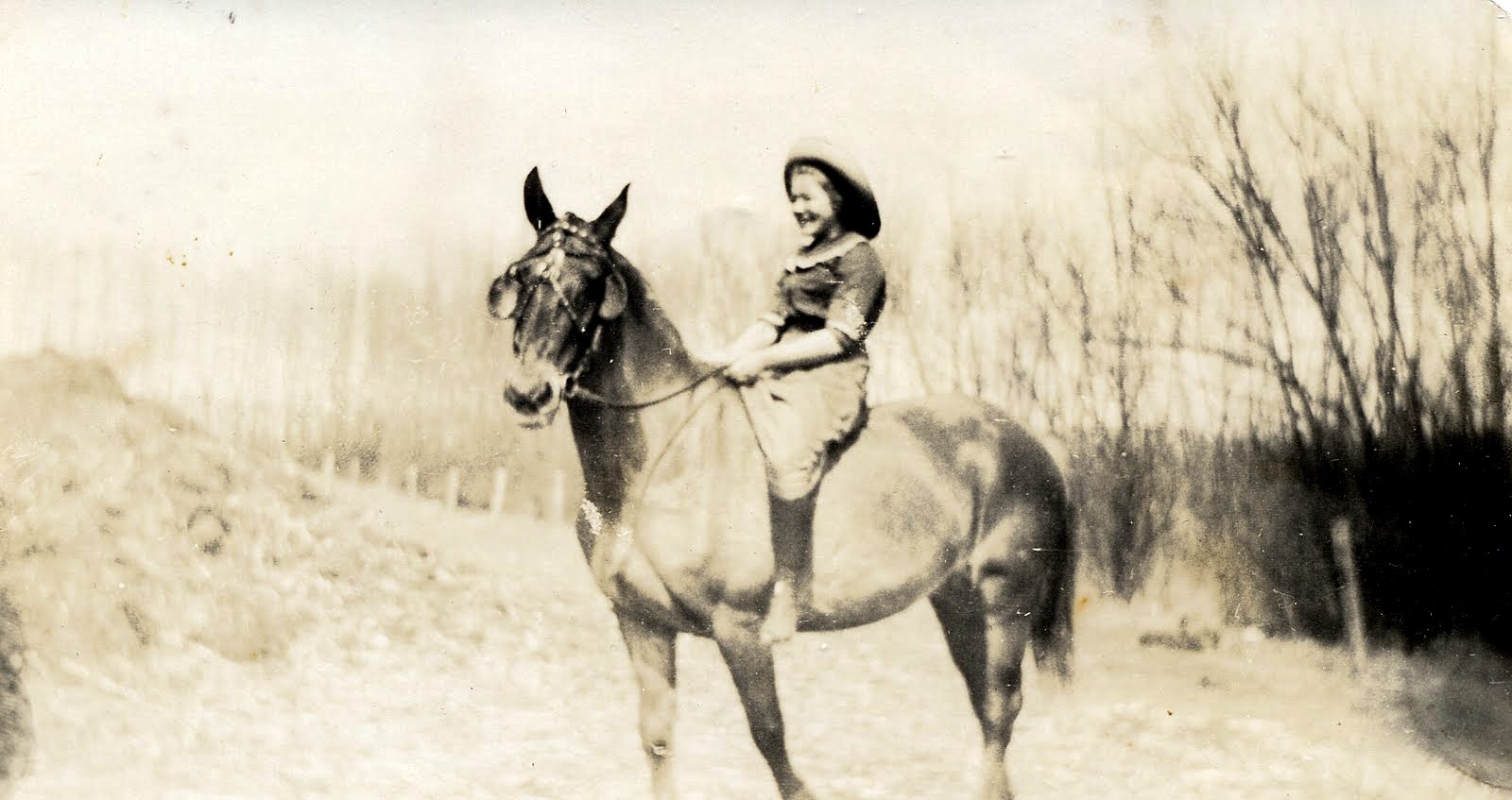

Mabel Johnson out riding.  Fosston, Minnesota, ca. 1912.
The long drive from the Bay Area to Salem, Oregon only made our visits with the relatives even more special for me.  We made sure to stop and see each relative from the home base of my aunt Phyllis's house.  This included my grandfather and all of his Oregon-residing siblings, plus some cousins.  My parents, sister and I were so stuffed from doughnuts, cookies, sandwiches, pasta or jello salads (and endless cups of coffee for the elders), we thought we'd never make through the day.  From those summer vacations of decades ago, I have lasting memories of my great aunts and the way they lived, laughed, and coped.  They turned the other cheek at any sign of trouble, and never let on if they felt nervous or afraid.  As capable as their pioneering parents and the Norwegian farmers before them, my great aunts lived each day as if tomorrow could not phase them... whatever the weather. 

Sunday, March 17, 2013

Happy Birthday to Mom!


Bill and Doris Wheeler as newlyweds in 1954

This photo was taken shortly after my parents were married, on the steps of the duplex they shared in Berkeley, California for a few months before purchasing their own house.  Today, Mom is celebrating her 93rd birthday, and I would like to share this poem in her honor.


A Prayer for a Mother's Birthday

by Henry Van Dyke


Lord Jesus, Thou hast known
A mother's love and tender care:
And Thou wilt hear, while for my own
Mother most dear I make this birthday prayer.

Protect her life, I pray,
Who gave the gift of life to me;
And may she know, from day to day,
The deepening glow of Life that comes from Thee.

As once upon her breast
Fearless and well content I lay,
So let her heart, on Thee at rest,
Feel fears depart and troubles fade away.

Her every wish fulfill;
And even if Thou must refuse
In anything, let Thy wise will
A comfort bring such as kind mothers use.

Ah, hold her by the hand,
As once her hand held mine;
And though she may not understand
Life's winding way, lead her in peace divine.
I cannot pay my debt
For all the love that she has given;
But Thou, love's Lord, wilt not forget
Her due reward,--bless her in earth and heaven.      

Sunday, March 10, 2013

Peek-A-Boo, Malla, We Found You

Malla Larson, at about age 16,
 ca. 1884 (this is the earliest
known photo of my great
 grandmother). 
Every family historian knows how maddening it can be when a source cannot be found to prove data that is well known by the family.  Some people call that a "brick wall," but you could also call it just plain frustrating.  Several family historians approached the problem of finding a birth or baptism date for my maternal great grandmother at different times, with no "proof" found other than what was written in the family Bible.

Malla (Vigesaa) (Larson) Johnson always told her family that she was born in LaCrosse, Wisconsin on April 20, 1868.  One thing I soon realized about my Norwegians ancestors is that they assumed major landmarks would stick in people's heads better than too much detail.  So, rather than specifically identifying where she had been born, Malla simply referred to nearby LaCrosse.  The trouble is, no birth or baptism record was forthcoming using the standard searches.

It was apparent that we had to go right to early church records, if any existed. Through collaboration with a cousin-in-law who is writing a Larson family history, it was determined that Malla must have grown up in Coon Valley, Wisconsin, a stopping-off place for many early Norwegian immigrants.   We had found proof of other family members living there, but nothing about Malla relating to Coon Valley.  She was still a child when the Erik and Kjersten Larson family relocated to Chippewa County, Minnesota and began homesteading.  We also knew that the family would not have attended any church other than Lutheran, which narrowed down the possible records.

It turns out that records for the Upper Coon Valley Lutheran Church in Wisconsin are only available in one place:  the LaCrosse Public Library.  I knew that if we were going to find anything on Malla's birth data, it would probably be on microfilm from that library.  Unhappily, I could not access the microfilm via interlibrary loan, so I began calculating how many years it might take before I could personally visit LaCrosse.  Too many, it seemed.

If we are patient enough, sometimes good things have a way of just happening (continual networking doesn't hurt, either).  I was just now contacted by a cousin-in-law, Nancy Larson, who has been working on a family history of our branch of the Larsons.  She made a new internet contact about whom she said, "It turns out she lives in Wisconsin. Turns out she works at a genealogy library, specializing in Norwegian research."  My cousin's new contact, after accessing the church records of interest on microfilm owned by the ELCA Archives (Evangelical Lutheran Church of America), came up with the following information:

#19 - Molla (Malla) b. 20 April, 1868, bap. 22 May, daughter of Erick Larsen and Christine Olsdatter, witnesses Sven Pederson, Engebret Sinbakken, Anne Jensdatter, Johanne Bredesdatter

Source:  ELCA Film #29 Upper Coon Valley 1868 Baptisms 1868

Ah!  Our search for Malla Vigesaa Larson's proof of birth has ended, with special thanks to a sympathetic professional and fellow researcher somewhere in Wisconsin.  I guess my trip to LaCrosse can wait a little bit longer...

If you are having a difficult time finding data for any Lutheran-American ancestors, try the research information and services available at the ECLA Archives, as specified on their webpage regarding Genealogy and Microfilm.  When doing family history research, ECLA Archives staff recommend first checking census records, naturalization papers, city directories, or related sources, before considering congregational records, especially if you are not certain your relatives were Lutheran.

Friday, March 08, 2013

My Childhood Home: Then & Now


Oh, the places the internet can take you now.  It has been 12 years since I last visited the San Francisco Bay Area and drove by the house where I spent most of my childhood on Carlson Boulevard, in the Panhandle Annex of Richmond, California. I discovered that I need not drive all the way to California to see what's up in the old 'hood, however.  We can fly nearly anywhere via Google Maps and look down upon fields, yards, and rooftops, and engage in innocent voyeurism from afar much like a pedestrian taking an early morning stroll.  If these techniques do not offer enough input, then online real estate listings will provide the rest, including photographs of exteriors, and even interiors whenever properties go up for sale.  But, in these photos our old stomping grounds can often be unrecognizable due to removed walls, added windows and structures, completely updated kitchens, and the like.  One thing I did recognize in a current photograph of the exterior of my childhood home was a black lava boulder that became a fixture at the bottom of our walkway.  It is still there today... but, more about that in a bit.


View Larger Map

The Richmond Panhandle Annex is the neighborhood shaded in blue.

My mother was raised on a Minnesota farm, and as a young adult, she worked seasonally at Richmond canneries.  She knew how to save money on a low income, so she was able to provide the down payment on our bungalow after she married Dad.  Our first house could not have been more than 1,000 square feet, with a living room, two small bedrooms, one bath, a kitchen that looked out onto the backyard, and a dining room.  Off the dining room there was a laundry room that connected to the one-car garage, and hiding underneath the laundry room was a small concrete cellar, intended as a air-raid shelter.  The house was built along the west coast during the threat of U. S. involvement in World War II (1940), and the architect seems to have taken family security quite seriously.  The cellar was accessed by lifting up an angled double-door, which sat against the back of the house much like an old-fashioned tornado shelter.  When Mom later had a family room built along that exterior back wall, a trap door in the laundry room floor became the only access.  A sump pump was installed in the cellar floor to deal with the constant moisture problem, courtesy of San Francisco Bay.  We always did battle mildew in that house.

Our lot was 7,500 square feet, bordered to the north by another single-family bungalow, and to the south by a two-story tri-plex apartment building.  Like most homes, the garage served us well for storage, and Dad's Ford fit nicely in the driveway.  The house was white with red shutters and a painted red porch and walkway, and it remained that way for many years.


Dad (Bill Wheeler) and me, with my favorite doll, Jane,  in front of the original shed at the back of the Carlson Blvd. house in April 1955.  We moved to the house that spring from a duplex apartment shared with Dad's cousin.

Growing up in the house on Carlson Boulevard meant a series of small things to me as a child.  Before my sister was born, and just after, I was regularly encouraged to play by myself in the backyard.  This meant regular visits with our beagle, who lived near the chicken coop and rabbit cage beside the shed.  The original shed that came with the house was later torn down and rebuilt by Dad and my maternal grandfather, Ernest Johnson.  The new shed was painted barn red to match the shutters on the house.  In addition to watching our animals, I spent my leisure time "popping" snapdragon flowers whenever Mom was not looking, climbing the wood fence to study the passion flowers growing over the neighbor's arbor, making cities out of baby powder cans and bottles on the lawn for my toy cars, or just laying on my back studying cloud formations.  When I was a little older and Mom was willing to trust me with the shed key, I sometimes took solitary sojourns to look at Dad's tools, even though I did not get to learn how to use many of them.  Still, I managed to pound more than a few nails into blocks of wood during those years, and came away with greasy enough hands that my shed adventures seemed satisfying enough.


The Wheeler home on Carlson Boulevard in Richmond, California, ca. 1956.

The essence of any family life, of course, is what goes on within four walls during the many hours of togetherness.  On Carlson Boulevard, my routine pretty much centered around a strict bedtime, and usually a breakfast of toast, jam and milk, the standard peanut butter or bologna sandwich for lunch with fruit and cookies, and whatever we had on hand for dinner: meatloaf, lamb or pork chops with potatoes, and (yuck) canned vegetables.  Whenever we had ham, it was the pre-cooked breakfast type that Mom would then fry to smithereens in a cast iron skillet.  Food was just sustenance, and she did what she could with the bargain groceries Dad sought out at the local Safeway.
 
My K-6 school days involved piano lessons from Mrs. Alva Anderson once a week before school, and walking the long blocks to Alvarado Elementary along a busy four-lane boulevard and under the busy I-80 overpass. More concrete awaited me at school, which was built atop a slope with a small play yard on the same level as the single story school building, and two large play yards cascading below.  Each level was separated by mountainous concrete embankments, with not a tree or a patch of dirt on the grounds, except for the small lawn at the office entrance. 

There are also sensual memories that linger from Carlson Boulevard, like listening to the mournful Alcatraz Island fog horn blaring from the middle of the Bay during periods of dense fog, and the tingling scent of eucalyptus trees in nearby Alvarado Park, part of the East Bay Wildcat Canyon Regional Park system.

As a new homeowner, Mom had visions of self-sufficiency like she experienced back on the farm.  There was at least one occasion when a batch of chicks was kept warm under a heat lamp on the laundry room floor, awaiting placement in the backyard chicken coop... ducklings, too, although they fared much less well than the chickens.  The poultry venture only lasted a few short years, however, until complaints from a neighbor put an end to our attempts at urban farming.  We have not been the only ones who were ever ignorant of zoning rules, however.  I had to laugh out loud in many places when I first read Farm City:  The Education of an Urban Farmer, by Novella Carpenter, which details an adventure in backyard self-sufficiency in nearby Oakland, in the midst of a more extreme urban environment than I ever experienced.

After my sister, Becky, was born,  she soon developed into a playmate with distinct preferences.  I do not remember how many hundreds of times I had to play "Mousetrap" on the living room floor or listen to the dreaded recording of "The Rooster With The Purple Head."  All for the love of family!  It was also at the house on Carlson where I watched the Beatles perform their famous stint on the Ed Sullivan Show in February 1964, and hid under the blankets at night after watching the terrifying "Creature From the Black Lagoon" on our black and white television set.  It was not my first sleepless night, however.  I never did understand why Mom made me sleep in her twin bed just after my sister was born, while she stayed with the baby in my bedroon.  Didn't she know that there were alligators living in her and Dad's closet, just waiting to slither across a darkened room and snap at stray little arms and legs?

The dark, sparkling lava boulder I mentioned earlier became a permanent part of our front yard in about 1960, though it was never intended to be. The "boulder incident" occurred during one of our annual vacations in Oregon. Each August, Dad would take his two weeks vacation from the Bell Packing plant in Emeryville and drive our 1957 Ford Ranch Wagon northward, to Salem. My mother had a fair number of relatives in the Salem area: my aunt, grandfather, great aunts and uncles, not to mention cousins. During one visit when I was about 8-10 years old, Dad took a couple of the men in the family to do some rock hounding, probably in eastern Oregon. While he was away from the others (bathroom break, perhaps), my great uncle, Frank Johnson, and a cousin, Harvey Moen, managed to displace a large volcanic rock from a nearby outcropping.  Dad returned to find a big object perched atop the station wagon, looking rather like a lighthouse optic section had sprouted on the roof.  He must have been angry, but Mom does not recall his showing more than a mild annoyance. He probably did not want to admit that he had been taken.  At 5'3" in height, Dad could not even begin to move the boulder on his own without damaging the wagon, and he never would have demanded help from the pranksters themselves.  I do not have any memory of what occurred after that, but Mom says we drove the 800 miles + back to the Bay Area with that lava rock perched atop the car. She was amazed that the Highway Patrol did not pull us over and ask about it. At home, a friend or neighbor helped lift the dense rock off the car.  Where the rock first came off the car is where it stayed, at the edge of the driveway. The boulder was so heavy that it left a crease on the roof of the Ford.


The Wheeler home on Carlson Blvd. in 1965.  Note the lava boulder at the bottom of the walkway steps, left-hand side, in front of the trailer.

  
Like most urban neighborhoods, Richmond, including the Annex, has had its ups and downs.  The City of Richmond, which borders San Francisco Bay, experienced a population explosion in the 1940s due to the shipyards and other wartime manufacturing.  But, decreasing industrial jobs after the war and the relocation of many businesses to newer areas created an economic depression, and property began losing value.  By the 1970s, the area was decaying rapidly.  As per example, other owners of the house on Carlson Boulevard had bars installed on the front door and windows at some point.  Richmond, sad to say, developed an infamous reputation based increased crime rates and gang activity over the past few decades.


The same house in 2001, some 36 years after my family moved to El Cerrito.  Bars had been installed on the front door and windows--a sign of significant change in the neighborhood. The lava boulder remains, barely visible below the door of the white pickup.

A comment was posted on Yelp:  City of Richmond by a former resident, and I could not have put it more eloquently:

This is not a review of Richmond, but a lament, really... Richmond is the best little city that could have been but never was. It has everything going for it, all the ingredients that could have made a nice town: great old architecture (what hasn't been torn down yet), cheap housing and some beautiful old houses, great location and weather. It used to be a real working man's town... Then they tore down downtown. Richmond has been the victim of poor urban planning, endemic racism (from all sides), and an inert and inept city government. Add crime, drugs and a huge population that has lost its ability to function without public assistance and it is a recipe for dysfunction...  don't get me wrong, I still like Richmond because I'm from there... Overall however, when I am there I just can't wait to get out again... One thing I have to say about growing up in Richmond is that I can definitely tell the difference between backfire and gunshot.

The good news is that the old neighborhood may be on the verge of re-surging values, both socially and economically.  Young business professionals, who are finding a shortage of affordable housing elsewhere in the Bay Area, are snapping up real estate "deals," and buying older, less expensive homes and refurbishing them to the max. The latest owners of my childhood home have not only taken off the iron bars, but the interior has been completely modernized in recent years, with a covered deck added to the backyard.  Things are now looking up again for the Panhandle Annex.  No matter what changes lie ahead for my childhood community, I will always have my memories of growing up as part of a Richmond blue collar family with strong, traditional values--a beginning as rock-solid as that lava boulder that still keeps guard along my old walkway.

Monday, February 18, 2013

"Whiskerinos" and the Golden Jubilee of Richmond, California


Ernest Johnson, age 58, dressed for the Golden
Jubilee in Richmond, California, August 1947.

I was quite surprised when I first saw this photograph of my maternal grandfather, Ernest Johnson, with a beard and moustache adorning his face. To my knowledge, he had never worn any facial hair, aside from an occasional unshaven stubble that he liked to rub against his grandchildrens' faces for their squeamish reactions.  My mother told me that when they both lived in Richmond, California, the city held a Golden Jubilee from August 22-24, 1947, to celebrate the 50th anniversary of the city's founding. Among the planned activities was a "Whiskerino" contest, for which "Richmond's male populace [had] been grooming their whiskers for weeks."  Grampa always seemed to be a team player, having been raised with nine siblings, so I'm sure he thoroughly enjoyed the anticipation of the events, and perhaps talked over plans time and time again in the break room with his fellow custodians at the Ford Plant.

In 1945, my grandfather moved to the west coast from Leonard, Minnesota, when he could no longer make an adequate living as a farmer.  By 1947, he had been a widower for over 25 years.  Richmond, California was a boom town during World War II, mostly because of the local shipyards and the tank production going on at the Ford Motor Company plant.  Housing shortages continued right after the war, so Grampa lived for a time in a boarding house and then rented a room above a water tower.  He was a modest man with simple needs, and he knew how to get those basic needs met by taking steaks or salmon from the Richmond Pier to his sister's nearby apartment on Sundays, in exchange for a good home-cooked meal.

Richmond's Golden Jubilee celebration was meant to serve as a reminder of the "good old days" in the history of the west. It seems that not just my grandfather, but many other Richmond residents had a lot of fun getting into the spirit. Here is a link to a privately owned collection of photographs taken during the Golden Jubilee parade in downtown Richmond, in August 1947.

The huge parade was not the only special event planned for the 3-day celebration.  Opening the festival was a mock raid on a downtown pharmacy by "Joaquin Marietta," an early California badman, along with his henchmen.  "Guns from both sides will blaze, but, as in olden times, the bandits will lose and will be carted off the 'jail' and kangaroo court," a local newspaper reported on the day before the commencement of the Jubilee.  Following an exciting start, there were plenty of activities to follow, including a hillbilly music contest, a Mexican festival, and a Saturday night costume ball at nearby Alvarado Park, for which all attendees were expected to wear pioneer dress.  I would like to have been a fly on the wall to see Grampa thoroughly enjoying himself, wearing his crinkly smile, and his sporty new whiskers, of course!


Sources:
"Raid to Open Richmond Fete."  The Oakland Tribune, August 21, 1947. p. 16, col. 1.

Thursday, February 14, 2013

The Magic of Mentors: Kenneth W. Landon

Once in awhile, I get around to blogging about my own life.  My experiences are part of a chain begun long ago by my Norwegian and Celtic ancestors, but they are much more culturally diluted as a 4th generation American.  The passage of time has a way of rarifying everything, and my own adventures do not yet have the same elusive sparkle as those of my ancestors.  But, when considering the highlights of my own life, I have to say that being fortunate enough to be guided and inspired by some mentors along the way is near the top of the list.  One of those short-term, but influential mentorships was by an astronomy instructor during the early 1970s at Contra Costa College in San Pablo, California, which is part of the San Francisco Bay Area.


DiscoverySchool.com
For a long time I have wondered whatever happened to Kenneth W. Landon.  Though he taught astronomy when I met him, he had also taught various science courses in junior and senior high schools, in addition to many years of instructing at Contra Costa Community College (CCC).  His alma mater was the University of California at Berkeley.  In the 1948 UCB Blue and Gold Yearbook, there is a photo of Kenneth Landon sitting with the Speech Arts Club as their spring President.  He is a rather formal looking young fellow with a blond pompadour atop a high forehead, slightly prominent ears, wearing a suit and tie and wire-rimmed spectacles.

Various internet searches on Landon's name usually brought up nothing, until just the other day, when I realized I had been remembering his first name incorrectly.  After applying new search terms, I was rewarded (sadly) with an obituary from last year.  I also found out that though he had lived in the Bay Area for many decades, he moved to the Puget Sound area in Washington State just three years before his death.  When I moved to Washington in 1979, how could I know that Mr. Landon would end up in Poulsbo--just across the Sound from me?  Well, small world.

When I took my first classes at CCC, I was truly "starry-eyed" over astronomy and science, in general.  Ever since my first visit to an observatory and planetarium as part of a Camp Fire outing during the 8th grade (Chabot Space and Science Center), and falling in love with the initial Star Trek TV series and classic science-fiction that same year, I was ravenous for more practical knowledge about the universe and how it worked.  I thought I had died and gone to heaven when an aunt gave me a book on astronomy for my 13th Christmas, and a quirky uncle gave me--still unbelievable--a small, but useful telescope.

Taking my interest in astronomy to a college level was quite exciting.  Mr. Landon had a great sense of humor and his lectures were entertaining, which was a big plus.  I remember one lecture in particular when he mentioned a book as a way to spark some student interest in how others were involved with astronomy:  Starlight Nights:  The Adventures of a Stargazer, by Leslie C. Peltier.  This 20th-Century memoir by a comet hunter was spot-on for neophytes who were curious about personal impressions from within the field of observational astronomy.  When I heard the title spoken, I nearly jumped out of my chair with excitement, wanting so much to call out and say that I'd already read it!  Instead, shy as I was, I made a point of visiting Mr. Landon in his office after classes that day, because I just had to tell him that his recommendation had already found its mark.  He was amazed that I had read Peltier's book and asked how I found out about it (this was years prior to the internet, of course).  I replied that I had actually been looking for something like that at the library, but did not mention how it radiated and scintillated like a globular cluster from among the astronomy books on the Dewey shelves, drawing me in helplessly.

We talked further that afternoon about my interest in astronomy and his teaching career.  Though he obtained an undergraduate degree in zoology, he soon decided that he enjoyed all science, especially the physical sciences, but had no desire to go back and do the whole college thing all over again.  So, he determined that he could teach a variety of science classes, and in doing so, keep his interest in each discipline alive and growing.  From that brief discussion, I learned that one should never dismiss viable options.  If you have a love of something, there is always a way to work it into your life, and if you can work it into your career, even better!

I did not go into astronomy as a career, after all, because I had to face that my greatest aptitude was not with numbers, but with words.  Instead, I took a path toward the library environment, as well as writing, which were equally major interests of mine.  But, after CCC, I continued on to San Francisco State University to take classes in astronomy, planetarium science, physics and higher math, and I think that without Mr. Landon's catchy enthusiasm and encouragement, I might not have had the self-confidence to even try.

Although I do not "practice" astronomy now, I am always interested in the latest discoveries and have a great appreciation of the physical sciences.  Mostly, I am very thankful for the Mr. Landons in this world, and the lasting legacy they offer to those who are willing to listen.  Through their teaching and support, nothing less than the magic of the universe is attainable.

Wednesday, February 13, 2013

Valentines of 100 Years Ago

One of my favorite things is looking through antique stores.  Lately, I've been foregoing spending time examining Depression Glass and linens in favor of smaller items that tell clearer stories about the owner:  photographs, and especially, postcards.  This last weekend I found a romantic treasure:  a Valentine sent by a lonely and lovesick wife in Penticton, British Columbia, Canada, to a husband away on business in Calgary, Alberta.  Judging by the fact that Willie kept the postcard, since it ended up in an antique store over a hundred years later, I suspect that he loved and honored his wife very much, and that there was no cause for her to worry.  Still, what lovers have not felt the insecurity associated with being out of one another's sight for too long? Ah, young love!


Dear Sweetheart,

I love you... Why are you not writing?  Have you another girl?  Remember your promise.  I am well but I can't live without you, Willie.  Please write soon.

Your wife,

"Dolly"

Monday, February 11, 2013

Valentines for Eternity: Eric and Bertina Winje


Ancestry.com recently published a Valentines Day feature, Discovering True Love
There’s a story behind that marriage date. But unless the tale has been passed down through family lore or you’re the proud owner of a collection of torrid love letters, you’re never going to get it, right?

Don’t give up so easily. Turns out that story of true love could be hiding in a yearbook or a census record. Or it may be waiting in a document or photo that you’ve already found, viewed, and saved … just waiting for you to take a second look.

This Ancestry.com article inspired me to write about a love story from among my own ancestors.  Although Eric and Bertina Winje are not the only examples of loving and lasting relationships from among my mother's ancestors, the challenges this particular couple faced never cease to amaze me.  Theirs was a relationship that weathered much of the spectrum of life and was still as strong as ever in its final moments.  But, in many ways, it is just another "everyday" love story from among our courageous immigrant ancestors.


Eric L. and Bertina Winje, 1915.

As anyone who has ever loved knows, love is not all sweetness and light.  Real love includes many bumps along the way:  give and take, up and down, light and shadow, and so on, plus plenty of personal sacrifice.  My great great grandmother, Thibertine (Johnson), or "Bertina" as she was called, with her second husband, Eric L. Winje, encountered great joy, inescapable tragedy, and everything inbetween during their time as a couple.  The point is that they encountered everything together for 56 years, and the bond made them even closer.

Bertina was the petite, good-natured, auburn-haired wife of an immigrant farmer, Baard Johnson.  The Johnsons arrived in the U. S. in 1866 from Nord-Troendelag, Norway, along with their two children, Ole M. and Ellen Julie, and began homesteading on prairie land in Chippewa County, Minnesota.  When Baard died from typhoid fever in 1872, Bertina found herself quite alone with two underage children, an 80-acre farm to manage, and a homestead contract that had not yet met the government requirements of five years working and living on the land.  She could have lost everything if the right man had not come along in time.

Lars and Ragnild Winje, Norwegian immigrants who homesteaded near to the Johnsons, had a grown son named Eric.  In 1872, Eric was 21 years old, which was ten years Bertina Johnson's junior, and at 5 feet 11 inches, he was more than a foot taller.  Eric was a good looking young man with brown hair, gray eyes, a smallish mouth, and an "ordinary" nose, according to his passport application of 1895.  The two began a relationship in the months following Baard Johnson's death.  Being of the same community, the pair had initially met at the local Lutheran Church or other gathering.  Perhaps Bertina had even hired Eric Winje to help out on the farm during the weeks of her husband's illness or after his death.

Eric Winje and Bertina Johnson quickly decided that togetherness was a good thing.  They began living together as common-law spouses and had a baby girl in 1873 (Berthe Regine, or "Regina"), but were not married until March 15, 1874.  The delay in the marriage date was planned in order to protect the legal interests of Bertina's eldest son, Ole M. Johnson, who stood to inherit his father's property.  If Bertina had married Eric Winje before the homestead requirement was completed under her first husband's name, they would have had to begin anew under Eric Winje's application.  The delay of the marriage, as well as protecting his stepson's interest in the land ownership, was definitely a sacrifice for love and honor on Winje's part.

Winje was an intelligent man who was driven to better himself and his family's situation.  While working as the county clerk for Chippewa County in Montevideo, Minnesota, he read for the law in his spare time and passed the bar exam.  He also worked as a Justice of the Peace and even officiated at his stepson's wedding.  The Winjes then gave up the family homestead in Granite Falls Township to Bertina's grown son, Ole M. Johnson, and moved into a house in Montevideo to accomodate their growing young family.  Their children would eventually number eight in all:  Regina, Louis, Lena, Emma M., Emma Thalette, Edward, Hattie, and Annie.

After the first son, Louis, was born to Eric and Bertina in September 1874, the couple gave their one-year-old daughter, Regina, to be raised by Eric's parents.  In Norwegian families, children were often placed where it made the most sense.  Perhaps the grandparents had admired the little girl so much that the couple offered her up as company and a helpmate for Lars and Ragnild Winje's elder years.  It is most certain that Bertina helped come to this decision, but it had to be a loving sacrifice on her part to give up her beautiful little daughter to Eric's parents, even if they were close enough to see her on a regular basis.  In 1878, Eric and Bertina lost their fourth-born (Emma M.), to diphtheria, while she was still a baby.

In 1887, Winje accepted a position as attorney in Duluth, and the family moved across the state.  Duluth was an up and coming port town during those years, and Eric's professional urban career afforded the family a new social stature, as Bertina and the children began to adjust to city life and its amenities.  Eric increased his community involvement and was elected Municipal Court Judge.  Several of the Winje children attended and graduated from Duluth Central High School.  By then, Bertina could probably not believe the difference between her prior life as a poor immigrant homesteader and her new life as the wife of a Duluth judge.  The couple, though still not rich by any means, purchased a steam launch and entertained family and friends on the waterways surrounding the city.  They also attended many local cultural and campaigning events.

Tragedy struck the Winjes a few short years later when a diphtheria epidemic in 1888 took their two little red-haired daughters, Hattie (5), and Annie (2), the youngest members of the family.  Meanwhile, back in Chippewa County, Eric's younger brother had also succumbed to the same disease a few days earlier.  But, even these occurences were not the last of bitter sadness for Eric and Bertina.  In 1893, their eldest son, Louis, drowned during a boating accident on their steam launch, the Ellida.  Louis had been studying law at Minnesota University in Minneapolis, and the promise of the future generation rested upon his shoulders.  Louis, who was said to be the epitome of his father in intelligence and character, was expected to bring to fruition all of Eric and Bertina's immigrant dreams.  But, it would never be.  During an August evening, Eric Winje was piloting the steam launch without running lights during the hours of dusk on Lake Superior, headed home with his son after a long day's excursion.  The weather conditions at the time are unknown, but the steam launch went unseen by a passing ferry and a collision resulted.  Eric somehow remained on the sinking launch and was rescued by ferry personnel, but Louis either jumped or fell off the launch during the collision and drowned.  His body was not recovered for several days.  How Louis's death must have weighed on Eric's conscience throughout the years, whether he could have helped the situation or not.  And, how many times must Bertina have called upon the grace of God to give her understanding and forgiveness, trying all the while not to hold her husband responsible for their son's untimely death.

A few years later, the Winjes' eldest daughter, Regina, died at the age of 25, a week after giving birth to her fifth son.  Following Regina's death, Eric and Bertina had three living children remaining out of the initial eight.  In an example of "what goes around, comes around," they took Regina's newborn child, Thomas Raymond Strand, to raise as their own, just as Eric's own parents had taken Regina to raise as a young girl.  Regina's four older sons continued to be raised by their father with the help of a housekeeper, whom he later married.

By this time, Eric's law career in Duluth seemed stalled by his inability to get re-elected as Municipal Court Judge.  Change called out to the couple and they left Duluth for Renville County, Minnesota, which was closer to their original home in Chippewa County.  Eric Winje summoned up the ideals and aspirations of his youth and ran for the State Senate through the Democratic party, but withdrew before the election in favor of another candidate.  The Winjes' next move was to Detroit Lakes in Becker County, where their lives settled into cautious comfort once more.  Winje again served as a judge for Detroit Lakes.  Their daughters, Lena Marie and Emma Thalette, continued to live with them during their elder years, while their son Edward sought new adventures as a homesteader in Canada.  Lena taught school and eventually became a school superintendant, while Emma Thalette, also a teacher, eventually chose to teach piano from their home while caring for their parents.

The couple's last loving sacrifice came during a period when Eric Winje's health began to fail.  Their daughter, Lena, wrote in a letter to her half-brother, Ole M. Johnson, that "Father has tried everything he could to make [himself] well, but it was of no use."  Bertina, who was by then suffering from dementia, developed pneumonia while bedridden.  In early 1930, when Eric passed away at the closest hospital in Fargo, North Dakota, Lena and Emma were not sure if their mother had even been aware of their father's illness.

Science has determined that even an unconscious mind is somewhat aware of what is going on nearby.  I believe that with everything the Winjes endured together, how could Bertina not miss the sound of her husband's voice or his presence about the house, even if she did not appear to be aware of any change?   When Eric's absence became apparent to Bertina, perhaps communicated through the sadness of a daughter's touch, she may have taken comfort in the promise of their wedding vows of so many years before:  "...in sickness and in health, 'til death do us part."  On February 15, 1930, the day after Valentines Day, Bertina followed her loyal companion to the grave.  After having given one another a lifetime of growth, fulfillment, and loving support, the Winjes were buried next to each other at Scandia Cemetery overlooking Lake Superior, near several of their children.

Saturday, January 26, 2013

Distractions Down on the Farm


Visiting with Native American Girls at Itasca
 State Park, Minnesota, 1935.  Back row (l to r):
  Mabel Johnson, Ella Moen, and Doris Johnson.

Sunday, January 20, 2013

Treasuring the Message of Family Artifacts, or, How Not to Break A Grandparent's Heart

This post has little to do with anything exclusively Norwegian-American, but everything to do with the importance of treasuring one's heritage through family artifacts.

Family historians thrive on the detective work of eeking out details of their ancestors' lives and placing their experiences within the context of social history.  It is a challenging, but very rewarding effort.  With all the time and work involved in ferreting out past data and fading stories, the results are incomplete, at best.  Primary resources that are actually created by ancestors, such as letters or memoirs, are more valuable than gold.  Not only are they rare, but they offer intimate insight into the ancestor's own thoughts, attitudes, and activities, and give us a much greater connection than we would otherwise have.

Most people, let alone genealogists and family historians, understand the value of keeping safe any kind of personal family memento handed down to them.  These are usually irreplaceable, one-of-a-kind items.  This general rule of thumb stands even more for materials that were written or created by an ancestor and autographed/inscribed for a particular family member.

In my spare time, I research and write about family history, but I also research topics for historical non-fiction projects, especially biography.  It is inevitable that once I start to get familiar with a person as a research subject, I experience many of the same feelings of closeness and empathy for unrelated individuals, as I do for family members and ancestors.  This leads to my story about a recent book purchase, where the author is one of these non-relations.

A few days ago, I ordered a used copy of a book online, because I saw the author had made several references to one of my current research subjects.  When I received the book in the mail from Amazon.com, I happily found the inside cover to be signed by the author himself.  But, what the author had written along with his signature tore at my heart:  "Christmas 2004.  To ('Name') with love, Grandpa B-----."

Here then, were memoirs written and published by a local Seattle man, regarding his passionate, lifelong involvement with a fascinating and unique hobby.  He had inscribed a copy of the book, newly published in 2004, to a grandchild or great grandchild, only to have the copy wind up at Goodwill a few short years after his own death.  This saddens me.  Any of us who engage in personal or family record-keeping live in the hope that our family members, both now and in the future, will handle our dedicated efforts with care and respect, if not full appreciation.

Perhaps I am taking this too personally, because as a little girl, I longed to be close to my grandparents and other elders, but the opportunity did not arise. My one living grandfather resided far enough away that I saw him only occasionally until his death when I was 16, and my maternal grandmother, whom I miss knowing every day, died when my mother was not even two years of age. Perhaps it is easier for people to take things for granted now, when the increasing busy-ness of modern life offers so many distractions. Or, perhaps for those who have extended family in their daily lives, it is common to focus on negatives instead of the good fortune of having the intimacy of family nearby in the first place.  But, I assure you that if I had a book of memoirs written and published by a grandparent that was personally inscribed to me, you'd better believe it would be harbored in the safest place imaginable. 

I realize there may be extenuating circumstances involved, but the family historian in me, and especially the sentimental woman/daughter/granddaughter, etc., just wants to cry out:   "What the hell happened?!"  How is it that this book, signed by the recipient's grandfather, was not held safe, or at least passed along to another family member?  A little "Googling" quickly showed me that extended family does exist, and so, I am being intentionally vague in this post out of privacy concerns.

I suppose it is possible that the recipient of the book experienced a change of circumstances.  Perhaps he/she was moving and wanted to discard any extraneous items, for example.  Although books are often the first to go in such situations, and another copy might eventually have been acquired in the future, it would not be the one that was personally inscribed by the grandparent.  If I knew who originally owned the book, and if a return were requested out of regret, I would gladly give it back.  But, sorry... in my mind, not even moving is a legitimate excuse for discarding the memoirs of a relative, whether published, or not (I hope my children will take note here).

I will probably always be in the dark about why a book of autobiographical essays given to a grandchild as a Christmas present, ended up at a second-hand store so soon after the grandparent's death.  But, I will read and learn from "Grandpa B's" memoirs, and will quote them as appropriate in my own work. The copy will then sit safely on my shelf, beside other collectible books on topics that are of great interest to me.  I hope that "Grandpa B" will rest in peace with the assurance that his voice has been heard, even if his heart's desire could not be protected from the uncertainty of time's passing, and the unpredictability of human nature.

Hold fast to your family treasures, because once they are gone, they are gone... and forever is a very long time.

Tuesday, December 04, 2012

A Flaming Christmas Tradition

(A repost from four years ago.)

This blog is primarily about Norwegian-American family history, so naturally, you might assume that I would write about a Christmas tradition that crossed the Atlantic Ocean with my ancestors a century and a half ago.  Or, perhaps a story from 80 years ago, when my farming family members were content with modest pleasures for the holidays: a box of apples, a bag of nuts, and a package of ribbon candy brought home by a horse-drawn sleigh through the snow. Then, there is always the puzzling tradition that Norwegian-Americans are still known for: the inevitable holiday consumption of lutefisk.

But, this time, I would instead like to tell you about a more recent holiday tradition: the "Flaming Ice Cream Snowballs" that were always served on the Christmas Eves of my childhood.

Flaming ice cream? Was this something like Baked Alaska--doused with alcohol and artistic flare, and brought to the table consumed in a glorious blue flame? Or, perhaps Snowballs were more related to international-flavored crunchy fried ice cream enjoyed in Mexican Restaurants? But no, the humble Flaming Ice Cream Snowball had a more commercial, blue collar beginning.


Soon after Foremost Dairy Foods created Flaming Ice Cream Snowballs, my mother discovered them in the frozen food compartment at the local Safeway store in Richmond, California. Each year during most of the Fifties and Sixties, they seemed to appear in the store right after Thanksgiving and disappear after the supply had run dry on about New Year's. Mom never failed to remind Dad, who did the majority of the family grocery shopping back then, to "be sure and bring home the snowballs!"

It was no matter that Snowballs were a simple, relatively tasteless, fast food treat. The fact that they were a once-a-year opportunity made them very special to my sister and me, but I think Mom enjoyed the fun of them even more.

Each one was a ball of vanilla ice cream covered with icing, and then dipped into fine coconut. The top was iced with green and red frosting in the shape of a sprig of holly. The snowballs came a half dozen to a box, with a paper doily and red candle for each. When Mom served the snowballs for Christmas Eve dessert, she placed each one on a doily, and pushed a slender candle into the holly-shaped icing. As soon as she lit the candles, she would turn the dining room lights out so that we could all admire the Snowballs in their brief moment of glory. A minute or two later, on came the lights again; everyone blew out their candles and slowly began scrapping off small spoonfuls of the coconut icing before finishing the ice cream.

I do not recall when Snowballs disappeared from the grocery store frozen food cases, but Mom still misses them to this day. I sometimes find myself waxing nostalgic over the memory of them, too, but, it certainly isn't because of their taste. Over the course of a few years, their limited epicurean value suffered even more when the holly-shaped icing atop each Snowball was replaced by a plastic insert. Instead, the nostalgia felt is more due to the realization that even the smallest, most unassuming traditions can bond people, especially during the holidays. Old or new, traditions mean family and security--something we all continue to long for from year to year.

Written for the 61st edition of the Carnival of Genealogy


Image: Flaming Ice Cream Snowballs

Saturday, November 17, 2012

Just Because It's Set in Stone...


There is a very important lesson that any family historian, and indeed, any researcher, needs to learn, and that is to not trust any single source of information as solid fact, not even a headstone or memorial.


Just because it's set in stone, it doesn't mean it's a stone fact.


Perhaps just to ensure that I do not become overly confident as a researcher, two examples of why any one source of information cannot be trusted completely (including those engraved in stone) has hit home with me in recent weeks.  The first example is detailed out in my prior blog post:  Solving the Case of the Missing Civil War Soldier, Thor Paulsen Sloan.  For quite some time, I could not determine where my Norwegian-American Civil War soldier from Wisconsin was buried.  I deduced that his remains were unlikely to be lost, because although he was wounded on the battlefield at Kennesaw Mountain in June 1863, he died as a patient in a Union hospital a few days later.  It turns out that the reason I could not initially find the location of his burial plot was because his name and/or his regiment were recorded incorrectly on important sources: the interment record for the relocation of his remains from the Kennesaw Mountain area to the National Cemetery at Marietta, Georgia, and the headstone at his gravesite.

The second recent example was related to me by a presenter at a genealogy workshop I attended earlier this month.  Family History Expo is a large genealogy conference held each November in the Seattle area.  Eric Stroschein, professional genealogist, was speaking on the subject of genealogical proof standard and the importance of using proper sources and documentation during research.  He detailed a story that illustrated why any single fact should not be taken as the gold standard without a reasonable exhaustive search to back it up, using other sources.

A client had hired Stroschein to research a potential family connection with a Confederate soldier who drowned during an early submarine test dive.  The name of the lost soul was one of several etched on a memorial erected in dedication to the submarine crew members, who died in the line of duty.  The surname of the prospective ancestor was rather unique, and this aided Stroschein while searching among censuses, military records, and other sources.  But, although he was able to trace many records for an individual with the same unusual last name, that surname was always connected with a first name different from the one on the memorial.  In the end, Stroschein succeeded in proving, through Civil War pension records and other sources, that the first name of the client's ancestor is incorrect on the memorial.  Now, that was unexpected.

This possibility makes a genealogy hobbyist feel a little insecure, does it not?  To think that information recorded on official documents, or even on solid tributes, such as headstones and memorials, may contain errors perpetuated by careless or hapless record keepers or decision makers upon the deceased individual... for an eternity.  But, this is where genealogists can really make a difference.  Perhaps it is the excitement of the chase that keeps many of us interested in pursuing family history, but it also has to do with an obsession to set things straight--to weave the various manuscripts, artifacts, and stories into an assemblance that makes sense, and that hopefully, corrects as many errors as possible.

So, as you continue to research, remember to always look for the unexpected, and to conduct as exhaustive a search as possible to answer your genealogical questions.  Your ancestors just may be depending on you to set the record straight!

Thursday, October 18, 2012

Solving the Case of the Missing Civil War Soldier: Thor Paulsen Sloan


Only one branch of my mother's Norwegian-American family arrived in the United States early enough to be involved in the Civil War.  Thor Paulsen Sloan (Slaaen) gave his life fighting in the Union Army.  He died on June 27, 1864, as a result of wounds acquired during the Battle of Kennesaw Mountain, Georgia.  Sloan left the Gudbrandsdalen Valley, Oppland, Norway in 1856, along with his parents, Poul Torgeresen and Kari (Svensdatter) Slaaen, and his older brother, Torger Paulsen Slaaen.  The Slaaen Family settled in Coon Valley, Wisconsin, and owned 160 acres on Section 36, Town of Washington.  Thor, who farmed alongside his parents, was born in Nord-Fron, Oppland, Norway on May 20, 1834.  Described as 5 feet 8 inches tall, with blue eyes, dark hair, and a light complexion, he was known to be an intelligent and "quiet, honest, and conscientious man" who had beautiful handwriting. [Buslett, Fifteenth Wisconsin, p.361]


Sergeant Thor P. Sloan, ca. January 1862.
The beginning of the Civil War prompted Sloan to volunteer for military service.  Like many other Norwegian immigrants, he was prepared to give not just allegiance to his newly chosen country, but his life.  When Thor P. Slaaen enlisted for a three-year term in the Union Army on December 11, 1861, he began using an Americanized version of his name:  "Sloan."  At age 28, he was appointed to the rank of Sergeant in Company E of the 15th Wisconsin Regiment, known as the "Scandinavian Regiment."  The men of Company E referred to themselves as "Odin's Rifles."  Sloan spent three months in basic training at Camp Randall, leaving there in March 1862, to join the war with his regiment.  Until July 1863, military records list him as "present" with the 15th Wisconsin, participating in the siege of Island No. 10 on the Mississippi River in Tennessee,  the raid on Union City, Tennessee during the spring of 1862, the 400 mile retreat with General Buell to Louisville, Kentucky, and the Battle of Chaplin Hills at Perryville, Kentucky, and other events.

Thor P. Sloan in civilian clothing, ca. 1860.


The Battle of Murfreesboro in Tennessee, from December 1862 to January 1863--also called the battle of Stone River--brought the first serious casualties for the 15th Regiment. Sloan was taken prisoner during the battle, but he managed to escape soon after.  In a letter dated January 12, 1863, he wrote to his friend, Osten Rulland.  (Note: I have seen several translation versions of this letter from Norwegian to English; this version is printed in Waldemar Ager's Colonel Heg and His Boys.)


Dear Friend,

It is a long time now since I heard from you or sent you a letter.  First I must tell you that I am, thank God, hale and hearty as of this date.  Quite some time ago I heard that you had returned home and that you are in poor shape as to health.  This is very deplorable; but you can thank your lucky stars for having escaped the situation we are in.  What a life--what an existence!  And what miserable times and fierce struggles we have had to endure in storms and rough weather, both night and day.  And on top of this, the rations and supplies have generally been poor.  I can honestly say that I would care for neither gain nor anything else if I could only be out of the service, free and unfettered.  But there is no use talking.  a man must do his duty.

Briefly I also want to tell you that we have had a rather miserable Christmas, even though I, thank goodness, am in good health and ought to be satisfied.  But we have again endured much and seen many a human being mangled and in misery--all merely because of the politicians.

During the period from December 26 until January 4, I can say that we were lying with rifle in hand without any fire and at times with poor rations.  We took part in the battle at Knob Gap near Nolensville and later at Murfreesboro.  At Knob Gap we were very lucky as we did not lose a single man dead or wounded. But what a fix we were in at Murfreesboro where the enemy rushed at us by the thousands and showered us with bullets like a hailstorm.  It is a God's wonder that not everyone of us was shot down or taken prisoner, because we generally--when either the rebels or our force attacked--were bullheaded enough to stay to the very end.  On the last day of the fighting General Rosecrans said to our Brigadier General Carlin:  "If the troops in front of your brigade should fall back, then you must post your men and hold the enemy in check."  Carlin answered:  "I have only 800 men left of 2,000 and I fear that my men have lost courage and will do little now since they have always been in the front ranks."  To which Rosencrans replied:  "For the sake of the country, and for our own sake, you must do your best because your toops are now the only ones we can depend on."

At the time it did not matter because the rebels made no more attempts to pierce our line.  Our captain was killed and our lieutenant wounded.  Eleven men of my company were wounded.  Captain [Mons] Grinager was wounded, as was Captain Gustafson.  Lieutenant Fandberg and Captain Wilson were also wounded and Lieutenant Colonel McKee was killed.  All told we lost fifteen men killed, seventy wounded, and thirty-four missing--a total of 119 men.  Some of the wounded have later died.  There is fear of a renewed attack.

A sincere greeting to you and your parents as well as all my other acquaintances.  Best wishes to you.  If you are able to write, I hope you will send me a few words in return.

Thor P. Sloan


Sloan was appointed to the rank of 1st Sergeant of Company E on May 1, 1863, and in July, he was assigned as a clerk in the headquarters of Colonel Hans C. Heg's brigade.  On August 17, 1863, the brigade left Winchester, Tennessee to fight in the Chickamauga campaign, in which over half of the brigade's soldiers were killed, wounded, or taken prisoner.  Sloan survived and was detached from his regiment on November 18, 1863, to go on recruiting duty back in his home state of Wisconsin.  The break from battlefield action must have brought him a sense of relief beyond measure, but it was only temporary.

In March or April 1864, Sloan returned to his regiment and was commissioned as the First Lieutenant of Company E.  He then served with the 15th on Major General Sherman's effort to capture Atlanta, Georgia.  On June 21, during the battle of Kennesaw Mountain in Georgia, he was making coffee in camp along with Captain Gustafson and Lieutenant Simonsen.  An enemy grenade fell directly into the campfire and a fragment struck Sloan in the head.  He died in a nearby Army hospital in the town of Big Shanty a week later, on June 27, 1864.

Lt. Thor P. Sloan, like other casualties during the Civil War, was initially buried on his last battlefield--in this case, Kennesaw Mountain.  Following legislation enacted by Abraham Lincoln, the U. S. Government began to purchase land to create a system of National Cemeteries, in which to bury those who served in the military.  You can read more about it in this document:  History and Development of the National Cemetery Administration

It took some time to determine where Thor P. Sloan lies buried now.  In fact, it had been one of the biggest genealogy brick walls I had yet encountered.  Logic told me that Sloan was probably interred in a National Cemetery during the decades following the Civil War.  The likely location was Marietta National Cemetery in Georgia, which is closest to Kennesaw Mountain (Big Shanty, Georgia), and contains many burials of fatalities that occurred during the June 1864 battle.  But, no burial records anywhere revealed the ultimate resting place of Thor P. Sloan.  I was puzzled; it was unlikely that he was one of the many unidentified Civil War dead, since he died of his wounds while being treated in a hospital.

It was only recently that I tried yet another search on Ancestry.com.  This time, a search for variations of Sloan's name, including "T. P. Sloan" brought up a U. S. National interment document for "E. P. Sloan," who died on June 27, 1864, during the Battle of Kennesaw Mountain.  Aside from the first initial of the name, all of the facts were correct except for one glaring difference:  the document indicated that E. P. Sloan was from Company E of the 15th Ohio Regiment, whereas Thor P. Sloan served in the 15th Wisconsin Regiment.  When I checked the roster for the 15th Ohio Regiment, there was no "E. P. Sloan" listed.  I determined that the reason "Not Found" is written in red ink near the top of the document is because the name of the deceased could not be connected with the listed regiment.  But, allowing for the inevitable and frequent human errors that occur in record keeping, I suddenly knew who "E. P. Sloan" was.  He was most likely my ancestor, Thor Paulsen (T. P.) Sloan.  My brick wall had crumbled!


By consulting Findagrave.com, I was able to locate a photograph of "E. P. Sloan's" headstone at the Marietta National Cemetery in Cobb County, Georgia.  The headstone for Grave C2311 appears to be an exercise in cautious simplicity.  The interment record keepers could not verify "E. P. Sloan's" regiment, so they must have decided to leave everything off the marker but the name.  The marker looks decidedly stark and incomplete... lonely, in fact.


Thor P. Sloan's contributions to the Union Army's efforts are well documented in various Civil War records, as well as in books about the history of the 15th Wisconsin Regiment.  However, I find it ironic that, in death, Sloan's final resting place became somewhat of an enigma.  It leaves me wondering if any relative before me discovered the record-keeping error made during interment to Marietta National Cemetery.  I doubt that Sloan's immediate family would have been any wiser, because his father, mother, and brother only lived long enough to know Thor to be resting alongside the battlefield where he met his demise.  The interment of Sloan's remains in a National Cemetery seems to have occurred well after the deaths of the immediate family members.  In any case, it is unlikely that these early Coon Valley, Wisconsin farmers would have been able to make a trip to far-away Georgia to assess things for themselves.

Even more ironic than the confusion surrounding Sloan's final resting place, is that a man in determined service of his new host country could have endured so much and met such an unexpected demise.  After several years of constant horrors in primitive battle, suffering imprisonment and daily cold, hunger, and other discomforts, he died of wounds received while sitting over a coffee pot, just a few months shy of the completion of his tour of duty.

Such are the lessons of history, and of the unfairness of life.


The Family of Thor Paulsen Sloan:

Thor P. Sloan was a younger half-brother to my great great grandfather, Hans Thorsen Sloan (Slaaen).  Thor had one full sibling--also a brother:  Torger Paulsen Slaaen was born in Nord-Fron, Oppland, Norway on October 13, 1831.  Like his brother, Torger also served in the Civil War, which he survived.  He married Kari Engebretsen and had two children, Mari and Peter.  His wife, Kari, died in 1859, and Torger was married for a second time in 1863 to Sophia Pedersen Stroemstad.  They had four children:  Caroline, Karen, Theodor, and Julius.  When Torger died in 1890, he was buried in the Upper Coon Valley Cemetery in Wisconsin.

Thor P. Sloan's father, Poul (Paul) Torgersen Slaaen--the son of Torger Hougen--was born in Nord-Fron, Oppland, Norway on January 14, 1806. He died on January 22, 1882.   His wife, Kari (Svensdatter), was born on November 6, 1800 in Oppland, Norway and died on October 29, 1890.  Both husband and wife are buried in the Upper Coon Valley Cemetery (Wisconsin), some 800 miles apart from their fallen son, Thor.  Kari's headstone is pictured here (photos courtesy of Kevin Sloane of the Coon Valley area).


*************************
Sources:

--Ancestry.com (U. S. National Cemetery Interment Control Forms, 1928-1962)
--15th Wisconsin.net (http:www/15thwisconsin.net/15etps01.htm), accessed on March 31, 2008.
--Buslett, Ole Amundson.  Fifteenth Wisconsin (translation by Barbara G. Scott).  Ripon, Wis.:  B.G.Scott, 1999.
--Familysearch.com (Norway, Baptisms, 1634-1927)
--Findagrave.com (Grave of E. P. Sloan, Marietta National Cemetery, Cobb County, Georgia)
--Holand, Hjalmar R.  Coon Valley: An Historical Account of the Norwegian Congregations in Coon Valley.  Minneapolis, Minn.:  Augsburg Publishing House, 1928.
--Slaeen, Kari Svensdatter, photograph of headstone at Coon Valley Cemetery, Wisconsin, courtesy of Kevin Sloane of Viroqua, Wisconsin, October 2012.
--Sloan, Thor Paulsen, photograph:  courtesy of Dale and Lois Finch of Brainerd, Minnesota, July 2005.
--U. S. National Archives & Records Administration, Military Service Records, Union Civil War (1861-1865), Thor Paulsen Sloan.
--Waldemar Ager.  Colonel Heg and His Boys: A Norwegian Regiment in the American Civil War.  Northfield, Minnesota:  The Norwegian-American Historical Association, 2000.