Monday, October 29, 2007

Thanksgiving on the Other Side

Becky (Boo Boo) and Chery, 1961.
Richmond, California.
By "other side," I mean the other side of my family. The non-Norwegian side, to be specific.

While growing up in the Bay Area, my mother's Norwegian-American relatives lived mostly in Oregon and Minnesota--too far off to see during the holidays. Dad's family was close by, so we exchanged many visits for Thanksgiving and Christmas.

Dad never minded cooking the turkey. Each year, one was provided to him for the holiday season as an employee of the Bell Packing Company in Berkeley. He loved the attention that cooking the turkey brought, being an extrovert who craved attention and interaction and didn't get enough of either. So, Thanksgivings were often held at our house. There was little to look forward to aside from the company and the meal, because in the Bay Area, you don't get brisk weather and beautiful fall colors; instead, you get rain.
While waiting for the turkey to cook, all of us snarfed up plenty of olives, and celery sticks stuffed with cream cheese, heartily seasoned with beau monde. Beau monde is little more than MSG, which I now avoid like the plague, but, who knew in those days? Just how many brain cells I lost over Thanksgiving holidays has yet to be determined.
The only other time I remember Dad being interested in cooking was when he taught my little sister to make a sandwich, all the while singing: "...a pickle in the middle with the mustard on top!"


Dad (Bill Wheeler) and his turkey.
Thanksgiving Day, 1965, El Cerrito, California.

Dad was a cannery retort operator, and Mom was a homemaker, so my upbringing was pretty modest and low key. It was exciting to have a group of people descend upon us at any time, let alone during the holidays. The variety of people on Dad's side of the family was interesting to a shy girl who led a quiet life and was hungry for more information about the world, in general. While my little sister, "Boo Boo," ricocheted off people, the dog, and table legs, I sat on the sidelines and sopped everything up like a sponge, always longing to participate more in life than I was.


Uncle Bob

Bob was the proverbial "bachelor uncle" who came to each family gathering equipped with a pocket protector, and all the latest gadgets and accompanying knowledge. Tallish and slender with dark hair and black rimmed glasses, he looked like the stereotype of the engineer that he was. Bob worked for the 3-M Company, and in his spare time he tinkered with his old Volkswagen and all the technical toys his workplace could provide. Due to the nature of his job, his holiday gifts were amazing. For me, they included my first portable tape player (no, I mean the early kind, with REELS), and a telescope just at the moment when astronomy had become my passion. Oh, every kid from an income-challenged family deserves an uncle like Bob.
Uncle Buzz and Aunt Marge

Buzz was one of those rare creatures who actually made a decent living as a musician. His real name was Elmer, but, come on... if you were part of the San Francisco Beat scene, wouldn't you be tempted to change your name?

San Francisco has always had a nonconformist reputation. In the 1950s, it served as a catalyst for social change and the avant-guard, which included the Beat generation. San Francisco Chronicle columnist Herb Caen coined the term "Beatniks" to describe the young writers, philosophers, and poets who gravitated to the North Beach area in search of artistic freedom and intellectual expression. "Beatniks" was originally meant to be an unflattering term, but was later embraced to become sort of a badge of honor.[1]


From about 1948 on, the Purple Onion, a celebrated cellar club in the North Beach area, personified the Beat era with its jazz and folk music, and smoky ambiance. Buzz was the resident bass player at the Purple Onion for many years. The intimate, 80-person setting hosted many up and coming entertainers: Woody Allen, Phyllis Diller, the Smothers Brothers, and the Kingston Trio, to name a few.[2]


Excerpt from the Oakland Tribune, 16 July, 1958, p.35, col.6

...Tonight is the night to revel it up a little with the East Bay chapter of the Hungry i, Purple Onion and Opus I.  If you are considered avant garde in your circle--this is aimed as a direct suggestion.  Buzz Wheeler at the piano, Gene Duncan's "Jericho" and Carol Frances are all people to go home talking about.  Nightly except Sunday, Monday, and Tuesday.

Buzz's main instrument was the piano, but as a highly respected bass player on the Beat scene, he was sought after by many other musicians. He performed with Charles Mingus, and was included on the 1949 recording of "Lyon's Roar" and "Pennies from Heaven" from the LP: "Baron Mingus and his Rhythm."[3]

He also played upright bass on all of the tracks on the Kingston Trio's first album (Scotch and Soda, recorded on February 5, 1958. Album: THE KINGSTON TRIO, Capitol T-996. Released June 2, 1958). Buzz was enlisted in order to give "some polish to the group's somewhat rough, 'homegrown' accompaniment." The track provided Buzz with a "showcase that decades of future bass practitioners have envied and sought to emulate."[4]
Scotch and Soda
(partial lyrics)

Scotch and soda, mud in your eye.
Baby, do I feel high,
oh, me, oh, my. Do I feel high.
Dry martini, jigger of gin.
Oh, what a spell you've got me in,
oh, my. Do I feel high.


And, if you ever watch old Woody Woodpecker cartoons, listen carefully to those jazz tracks that include a bass... that's Buzz, too!

Buzz's wife, Marge, was also in the music business. She sang, while Buzz played accompaniment on the piano, and writers, lurkers, and music lovers sat in half-lit shadows, clinking their whiskey-flavored ice cubes and stirring martinis with stemmed cherries.

When I knew Marge, her long, straight and frizzy red hair, which she always wore in a high ponytail, had faded mostly to grey. But, in earlier days, with that pretty, welcoming face and red ponytail, she must have looked striking on stage in a black turtleneck and leggings.

Her sweet, breathy voice turned raspy after years of hard smoking, but her everyday speech was lyrical in itself. Marge was relaxed and she knew how to laugh. She was also a huggy-kissy person, much to my mother's dismay, but not in an ungenuine way. It's just that Mom's rather stoic farm upbringing dictated that while it was okay to kiss one's children on the lips, the line should be drawn at in-laws.

When I was a child, I had no knowledge of Marge's artistic inclinations. It was amazing enough that her favorite color was orange and that she shopped regularly at import stores. I didn't even know where to find one.


Grandpa McKinley and Grandma Margaret

McKinley had the congenial and deliberate air of a southern gent, but he hailed from the Midwest. He was fond of wearing western ties with white shirts.  Unfortunately, that gentlemanly air hid something much darker that many family members knew nothing about until years after his death.

His wife, Margaret, was a woman who would give you the blouse off her back, but if she talked you into her big white Pontiac to let her help you run an errand, she would soon have you hiding in the back seat, under a blanket, repeating a prayer. Everything about Margaret was fast. She drove fast, talked fast, and she walked fast. As a matter of fact, she ran: in the house, and outside. Margaret always ran instead of walked, and she wore her slippers everywhere.

Margaret had three sisters who were close in age: Lillian, Florence, and Vivian. The sisters must have had a lot of fun growing up together in the urban Bay Area, when rapid growth following the 1906 San Francisco earthquake changed everyone's life for the better. One can image them sitting for a photograph on the steps of a glorious old Victorian house, posing in proper, lacy, white dresses with huge satin bows at the backs of their long tresses. Straining to hold both breath and facial expression for a minute, when given the signal they rose in a competitive, congenial whirlwind, as only sisters can do.


The Cousins

I had a cousin who was exactly the same age as me, and one who was younger. But, it was their two older sisters who provided the most entertainment.

To a 1960s pre-teen girl, the world of makeup, hair, clothes, and dating was like a different planet. Just sitting and listening to these girls talk provided plenty of input to digest until the next Thanksgiving rolled around. It was even more exciting when a Scottish cousin moved in with the family to get an American education, and joined the holiday mix. Fresh from the land of the Beatles (Edinburgh was close enough), with bright red hair and copious freckles, Jane was like heather wine, an exotic representative of the world at large.

The others complained that Jane liked to tell stories in order to get attention. I wouldn't have known the difference, because I had a hard enough time understanding her thick accent, anyway. But, I did enjoy my alone time with Jane once when she spent the night, and we giggled under the blankets with our "Black Cow" candy after being frightened by the movie, "Creature from the Black Lagoon."

Afterwards, she told me a story about her school, and how the boys and girls had physical ed class together. One day, the girls somehow all lost their uniforms and the teacher made them go to class in their underwear. I asked, "Didn't the boys mind?" She replied in all seriousness: "No, of course not!" She was 13 or 14, and I was 10, and maybe she hadn't realized I was just a tad too young to get the joke.

Uncle Ralph and Aunt Evelyn did their best to keep their charges in line, but the notion of a family having by-laws and using allowances and fines was strange to me. It was even stranger to think that a girl could get punished for something like wearing green eyeshadow. Worse than that was the idea that you could actually break a rule and live to tell about it. (Okay, so I was pretty naive.)

The people who filled the holidays of my early years are remembered and respected for the uniqueness they each brought to the family. There may never be another gathering for me quite like those of my childhood, but family interaction is important to the human spirit, especially to an impressionable young person. It is in the early years that indelible bonds and impressions are forged, and though the effects may not be realized immediately, they are long lasting.

So, go forth and make happy memories. The stress of modern life should not deter us from making human connections. Best yet, be sure to record those memories for generations to come.

A very happy and memorable Thanksgiving to you all.


Sources:
1 San Francisco: In Depth: History: The 1950's: The Beats, http://www.frommers.com/destinations/sanfrancisco/0029033658.html
2 Wikipedia, http://en.wikipedia.org/wiki/The_Purple_Onion

3 The Charles Mingus Catalog, http://www.jazzdisco.org/mingus/cat/a/

4 The Kingston Trio: The Guard Years: http://www.lazyka.com/linernotes/trio_01(Guard,Rynolds,Shane)/GuardYrsPages/.

Monday, October 22, 2007

"Snoqualmie Pass" now released!


SNOQUALMIE PASS
by John and Chery Kinnick

NOW AVAILABLE!

ARCADIA PUBLISHING
www.arcadiapublishing.com/

"Arcadia Publishing is the leading local history publisher in the United States, with a catalog of more than 4,000 titles in print and hundreds of new titles released every year."

  • Snoqualmie Pass (ISBN: 073854809X), was written as a cooperative effort between my husband and myself, and was meant as a tribute to the history of the community where we live.
  • Recently released to the market on October 8, 2007, Snoqualmie Pass is part of Arcadia's Images of America series. The book is available for $19.99 through the publisher's website: http://www.arcadiapublishing.com/.
  • As of October 22nd, Snoqualmie Pass has made the "Most Popular Items in Washington [State]" list on Amazon.com; more than 1,000 copies have already been sold through various booksellers!


Description from the back cover:


Situated in the Cascades about 50 miles east of Seattle, Snoqualmie Pass is intersected by the most heavily used route connecting eastern and western Washington. In the 1800s, use of the old Native American trail by explorers, cattlemen, and miners created a need for a wagon road. A railway and highway followed, and Snoqualmie Pass quickly developed into an all-season recreational paradise with over a half million visitors annually. Known for easy access to snow sports and the Alpine Lakes Wilderness area, nighttime ski operations, and the world-famous terrain of Alpental, Snoqualmie Pass is also a community of neighborhoods with both full-time and part-time residents who share a unique mountain lifestyle.


Snoqualmie Pass will appeal to skiers, hikers, and outdoor enthusiasts of any type, also to those who are attracted by the beauty and unique history of the Cascade Mountains and the beautiful Pacific Northwest.

The Images of America series celebrates the history of neighborhoods, towns, and cities across the county. Using archival photographs, each title presents the disctinctive stoies from the past that shape the cahracter of the commuynity today. Arcadia is proud to play a part in the preservation of local heritage, making history available to all.

Tuesday, September 25, 2007

We'll miss you, Karna

Remembering...


Karna Lou (Winje) Franche

April 28, 1938 - September 1, 2007


(Left to right), back row: Kenneth Moore, Bonnie (Simmons) Winje, Albert B. (Abbie) Winje, and Dennis W. Johnson; front row: Lori (Winje) Moore, Chery Kinnick, and Karna Franche. Photograph taken at the home of Abbie and Bonnie Winje, Salmo, British Columbia, August 2004.


Only a few months ago, Karna Franche was told she had incurable cancer, and was given a very short time to live.

Is there ever a perfect time to pass the baton? There will always be moments we wish we could steal, however near or far into the future. I'm sure that Karna, who was full of life and always busy, struggled with this. Caught up by a love of organization and planning, she had to try and accept that some of her projects would remain incomplete, and that come next spring, it would not be her own hands around the hoe that would stir the the soil of her garden into awakening. All too soon, her scrapbooks and notebooks would be closed and packed away, and many of her belongings scattered. How we mourn the loss of our tools that define our creativity, our needs, and our identities.

The oldest sibling in a family of five, mother to one, and "Auntie Karna" to others, Karna Franche died at age 69 on September 1st, and was buried at Slocan Cemetery in Slocan, British Columbia, Canada, next to her first husband, Keith Elmes. Her parents, Albert Lien and Agda Feddersen Winje, and grandparents, Edward Theodore and Bess Lien Winje, also rest there. Karna is survived by a daughter, Joanne Elmes, her husband, Roy Franche, a sister, Aloria (Lori) Moore, and three brothers: Albert (Abbie) Brian Winje, Edward Richard Winje, and Eric Dale Winje.


Edward Theodore Winje (1881-1969)


I only met with Karna once, but I shall always remember her energy and infectious enthusiasm for everything, including family history. I contacted the Winjes in British Columbia a few years ago because they are descendants of my great great grandmother, Thibertine Johnson, and her second husband, Eric Larsen Winje. Several family members pointed the way to Karna, who I was told was the keeper of the family mementos and photographs. We wrote long, informative letters back and forth. She was very excited about the family history book I was preparing, and we exchanged quite a lot of family information and materials.


Karna and Roy Franche, early 1990s.


In late August 2004, I went to up to the Kootenays to visit the Winjes, along with a cousin, Dennis Johnson, from Hayden Lake, Idaho. We stopped for a visit with Ken and Lori Moore in Creston, and enjoyed a family get-together at the home of Abbie and Bonnie Winje on their lovely farm in Salmo. We also stayed with Karna and her husband, Roy, and were given the royal treatment. Roy fixed us his special omelets for breakfast, and then he and Karna showed us around every corner of the Slocan area. All the while, Karna told us numerous stories about her father, Albert L. Winje, a one-time bush pilot, and her mother, Agda Fedderson Winje, who was born in Denmark and had served as Slocan's mayor. Agda Winje was mayor during a volatile part of the town's history, and Karna remembered with trepidation how her father and brothers watched for snipers from their windows at night.

After the deaths of Karna's parents, their house was leased out. The renter, while talking with Karna one day, asked who the lady in the pink bathrobe was, claiming she had seen a unfamiliar woman wandering through her kitchen. When she went to take a closer look, the strange woman had vanished. Karna replied that she didn't know anyone who currently fit the description given, but that her mother, Agda Winje, had always worn a pink bathrobe. (Was the Mayor still restless about the state of affairs in Slocan, or was she simply checking on the welfare of the family she left behind?)

Karna's father, Albert Lien Winje, was a colorful character. He and his brother Hugh grew up on the plains of Alberta and Northern Saskatchewan, and "had enough adventures to put Tom Sawyer and Huckleberry Finn to shame." [Winje, Albert L. It Happened in My Lifetime, p.7.] As a youth, Albert worked on his father's farm and in local sawmills. In 1946, he bought a war surplus Tiger Moth and taught himself to fly, becoming well known as a daredevil pilot. He made many mercy missions across the skies of the northern prairies, either bringing in medical care or flying people out to hospitals. After moving his family to Slocan, B. C., Albert became an avid collector of guns and farm machinery, and also created unique metal sculptures. His machinery and sculpture display ran for nearly half a mile along the British Columbia highway near his home. A man with a need for self expression, he devoted his last years to writing his memoirs, which were published in "It Happened In My Lifetime."


Winje, Albert L. "It Happened In My Lifetime." Kelvington, Saskatchewan: Kelvington Kronicle, 1995.


Karna had more than a few stories of her own to tell. Her grandfather, Edward Winje, enjoyed hunting and fishing while the family lived in Saskatchewan. Karna and her younger sister, Lori, often went along on the fishing trips because they loved the picnic lunches their Grandma Bess made. Typical teenagers, the girls thought they were really something sitting in the back of the car with their hair blowing in the wind. On one trip, some young fellows passed by in another car smiling widely and making eyes. Feeling smug because of the flirtatiousness of the boys, the girls were later mortified when they discovered Grandpa Winje’s old car was missing a tire. He had been driving on one of the rims all the way home, and that had been the real reason for all of the attention!

Karna Franche's personal legacy continues. Her love of family history, perhaps her greatest tool, has helped to ensure that future generations of Winjes will know something of their origins. Thank you, Karna... we'll miss you.


Wednesday, September 05, 2007

Home, Where Art Thou?


Something I read today starting me thinking about the meaning of home. After all, family history deals quite a bit with the subject of home, which is defined in dictionary terms thus:


Main Entry: home
Part of Speech: noun
2
Definition: birthplace
Synonyms: abode, camping ground*, country, element, environment, family, farm, fatherland, fireside*, habitat, habitation, haunt, haven, hearth, hills, home ground, homeland, homestead, hometown, household, land, locality, motherland, neighborhood, range, roof*, site, soil, stamping ground*, stomping ground*, territory
Notes: 1. hone means to sharpen, while home (in) means to seek out a target; you can hone a skill but you home in on something 2. a house is the building or structure in which one lives; home is the place one lives with the pleasant connotations or family ties included.

Source: Roget's New Millennium™ Thesaurus, First Edition (v 1.3.1)
Copyright © 2007 by Lexico Publishing Group, LLC. All rights reserved.

* = informal or slang

(footnoteMaven will be proud of me for that definition)


But, what is home, really? It is much more than a physicality. That homey feeling certainly involves settling on my favorite corner of the sofa with a mongo-size cup of Irish Breakfast Tea (with milk) after a long commute to the house where I live, and knowing that my loving husband and faithful canine companion are close by. (Or, is that my faithful husband and loving canine companion? Well, nevermind.)

Home is often something transitory or intangible - a spirituality, almost. In my quest to learn more about life, the universe, and everything, I have identified some things I cherish that give me a sense of belonging and feel like "home":

    1. My mother's tuneless humming under her breath as she sat knitting or crocheting: a habit she picked up from her grandmother, who picked it up from her mother, etc., and that I also catch myself doing from time to time.
    2. The pungent scent of eucalyptus--reminsicent of dry leaves stirred underfoot during childhood excursions in the San Francisco East Bay hills.
    3. Meeting a far-off cousin for the very first time, gazing into her face and thinking: "I know you."
    4. The taste of warm, soft lefse with butter.
    5. Becoming lost between lines from a great writer.
    6. Family postcards mailed long ago, caring thoughts scribbled from father to daughter, mother to son.
    7. The humid, sweet smells of home canning: peaches, applesauce, dark cherries, and strawberry jam.
    8. A first visit to the grave of a grandmother I have never met, yet miss every day.
    9. The word "Minnesota" (though I was born in California).
    10. Being safe in the arms of someone I love.

What does "home" mean to you, and how does it fit in with the study of family history, or of history in general? If "home is where the heart is," then home can be many things, including part of the past we have not personally experienced, but have learned about and become enriched by, through countless stories and customs, sporadic details, images, a sense of shared experiences, and our imagination.

Happy Homecoming!

Friday, August 10, 2007

The Irish Adventure of the Hannah Parr

Gulbran Olsen Berge, ca. 1870s.
Chippewa County, Minnesota.

On April 12, 1868, Gulbran Olsen Berge departed Christiania (Oslo), Norway for Quebec aboard the Norwegian emigrant sailing ship, Hannah Parr. Berge left behind a wife, Karen (Bue) Berge, and several children in Gudbrandsdalen Valley, Norway as he made his way to the United States to secure a new life for his family. The ship's list, published on the Norway Heritage website, recorded his passenger information as: Gulbrand Olsen Berget, 32, married - Residence Gausdal, Gudbrandsdalen.
The voyage of the Hannah Parr should have been just another routine crossing, despite primitive conditions that were common aboard early emigrant ships, but it ended up being one of the better documented sailing voyages in the history of early Norwegian-American migrations because of its exceptional nature. After the ship left Norway, it was not until 107 days later that the travelers finally reached their destination of North America, since severe storm damage forced them to make an extended layover in Ireland.

The Hannah Parr encountered severe weather when it reached the mid-Atlantic. On the second day of the storm, a large wave over the stern took out the pilothouse and its gear, as well as the kitchen, and left the ship with hardly any riggings or sail. After the storm subsided, the ship made its way slowly back to Ireland, where it docked for repairs at Limerick.

Gulbran Berge kept a diary throughout the voyage, though it consisted of mostly short reports about weather conditions. His descriptions became more extensive during and after the storm. For April 27-28, 1868, his notes read:


...We ran into a bad storm that lasted 2 days, and everyone thought they would die. The storm began the night of the 28th and lasted until 12 o'clock midnight of the 29th. We lost almost everything that was on the deck. The captain's quarters were completely wrecked. ...The kitchen was washed overboard. The sails and riggings were destroyed by the wind. ...The captain would have been blown off the ship if the one who steered the boat had not rescued him. The foremast was blown off, but we made some use of it. The captain said he had never been in such a storm before. He had never heard of another emigrant ship that it had happened to like it did to us. Three people were hurt, and some were so tired because they had not slept for 72 hours.


The ship turned about and headed back to the nearest land for repairs, anchoring temporarily in the Irish islands at the mouth of the Shannon estuary before continuing on to Limerick. On May 7, Berge wrote:

...Many came on board to sell food and other things. They took up the anchor, and since no steamboat had come we continued on our way because we had the tide with us [...] In between the rivers it was very pretty. The leaves, potatoes, and corn were as big as they were in mid-summer in Norway. When we came ashore we were met by many people, and they looked at us like we had come from another world. They followed us around so much we could hardly move. At night three or four men had to keep watch on deck, and every day hundreds of people came to look at the ship without sails.


While the Hannah Parr was undergoing repairs, there was a great deal of interaction between the traumatized Norwegian emigrants and their curious, hospitable, and lively Irish hosts:

May 10 - [We] all wished to go on a trip on the railroad for a few miles inland, and this was an enjoyable trip. Some gentlemen treated us to 40 pints of Port wine which was all drunk up, and some felt happy from it [most likely a translation mistake, since letters by other passengers mention "porter" (beer)].


May 11 - ...When we were in Limerick we had a very good time. The people did all they could to make it pleasant for us [...] Two hundred of us went to the theater, and even though none of us understood what they said, we enjoyed it. The work on the ship went slow... we were laid up there about six weeks. We sailed from Limerick the 9th of June, and although we were not ready we had to leave because the tide would go out so no ship could come in or go out for 10 days. We transferred to a steamship four miles out of town where we cast anchor to get ourselves entirely ready, and we thought we would be there only a few days. While we were anchored there, most of the passengers had to send word back to Limerick for food because we left in such a hurry we didn't get time to buy all we needed.

After departing the Irish coast to face the Atlantic once again, the Norwegian emigrants found that new passengers accompanied them on the remainder of the voyage, namely: lice, and the dreaded disease, typhoid fever. Only a few deaths resulted, however.

Clair O. Haugen and James Overdahl collaborated on Hannah Parr research, and Haugen wrote a background article for the Norway Heritage website: The LONG Crossing of the Hannah Parr. Also included online are Hannah Parr related photographs, the diary of Gulbran Olsen Berge, and letters by two of his fellow travelers describing events.


Hannah Parr the Subject of Arts Collaboration in Limerick

Recently, a children's theater group in Limerick, Ireland performed a play about events surrounding the 1868 voyage of the Hannah Parr, after discovering that some Norwegian children from the ship were buried in a local churchyard. With the help of Haugen and Overdahl, known Hannah Parr descendants were contacted and asked to submit vocal greetings to the Irish children, to help give a better sense of history of the ship and its passengers. In my own greeting, I asked the children to remember that "an act of kindness can last several lifetimes." Without the hospitality of the citizens of Limerick, my great great grandfather, Gulbran Olsen Berge, would not have continued his voyage to America. Had he not continued his travels at that time, it is likely that his son, Ole Benhart Berge, would never have met his Norwegian-American wife, and my grandmother would never have been born, and consequently, I would never have been born... and so it goes.

An Irish entertainment website contains a review of the collaboration between the Island Theatre Company, St Marys Local Arts Group, and the 16 children from Limerick who participated: Cheebah - Hannah Parr.

Growing New Roots on the Minnesota Prairie


Ole Benhardt Berge, 1869, Norway.

Karen Bue Berge, 1879s.
Chippewa County, Minnesota

The Berge family was eventually reunited a year later, in 1869, when Gulbran's wife. Karen, and their two children, Othillie and Ole, made the transatlantic crossing from Norway. It was the custom for family members to have photographs taken at the point of embarkation, and to mail them home as mementos. In 1869, little Ole was photographed with a miniature pipe in his mouth. It was a sight meant, no doubt, to make Farfar and Farmor extra proud of their grandson, the liten mann (little man) who was about to brave the open seas to help his papa make good in America. The pipe and the original box it was sold in is currently in the possession of one of Ole Benhart Berge's grandsons in Minnesota.
Gulbran and Karen Berge homesteaded in Leenthrop Township, Chippewa County, Minnesota, and had two more daughters after being reunited: Gunda and Sophie. Their son, Ole, who immigrated to America as a boy, eventually had 10 children of his own, one of whom was my grandmother, Esther Agnes Berge. Gulbran Olsen Berge died in his forties from tuberculosis; his death certificate indicates that he was interred at Saron Lutheran Cemetery, also in Leenthrop Township. Saron Lutheran Church, which was built a few years after Berge's death, does not include the grave in its registry, and a marker has not been found.

Many years after Gulbran's death, his sea voyage diaries were stored in a garage and became weather damaged. Only one volume of his notes survived, and it was translated from Norwegian to English by one of Gulbran and Karen Berge's daughters, after which the translation was distributed to many family members. So, because of multiple, individual steps, including the unexpected kindess of Irish strangers, and the passing down of an old weather-worn and nearly unreadable diary, this bit of Norwegian emigrant history has survived to inspire us all.

Inspiration, in my opinion, is what the pursuit of genealogy and family history is all about. Genealogy should never be an end unto itself, with family data existing merely as a collection of names and dates. When genealogy is combined with family and social history, a living timeline of people, events, and challenges can be woven together in a braided chain that serves to strengthen the meaning of our current reality. Thus, genealogy and family history mirror collective human experience in a very personal way.

Friday, July 06, 2007

Simply "Blogged Down" for Awhile

I thought I should write something before this blog withers away. Much of my spring and summer has been taken up by family health concerns. My husband recently had surgery: one down, one to go. He will be doing great in no time, so no worries. It has put a tiny damper on writing and research, but nonetheless, there is news.

I have a release date for my book of images: "Snoqualmie Pass," by John and Chery Kinnick (www.arcadiapublishing.com). It will be available beginning October 8. You will not find it listed on the website just yet, but info should appear well before the release date. I am also in the final prep stages for the family history I have been working on for five years; it will be going to the printers in August. I decided on a slight title change in order to make the family history subject matter more evident at a glance. I am currently taking pre-orders from family members for "A Long Way Downstream: the Life and Family of Thibertine Johnson Winje, Norwegian-American Pioneer."

I have also been gathering information on my next topic for the Nearby History writing seminar offered through Seattle's Museum of History and Industry - my second go around. During last year's seminar I met two exceptional ladies, Luci Baker Johnson and Cathy Lykes, who are also passionate about Norwegian American research. The three of us formed a writer's support group (the "Nearby Norwegians") and meet monthly to share ideas. We are completely invigorated by these sessions! For those of you thinking of forming or joining a writer's support group, I highly recommend it.

In the next blog post, I will write about my great great grandfather (Gulbran Olsen Berge) and his experience during the crossing of the Hannah Parr, a Norwegian immigrant ship. In 1868, it suffered major storm damage while setting out across the Atlantic, and had to limp back to Limerick, Ireland for extensive repairs. I am also hoping to update my website soon with images from an 1880s-1890s photograph album belonging to my great grandparents, Ole and Malla Johnson of Clearwater County, Minnesota.

So much genealogy, and so little time...

I wish you a family history-filled summer. Apologies to my relatives for not making the Anderson Family reunion in Minnesota this week... I know it must have been fun (especially the auction).

Friday, May 25, 2007

Winje Monument Repaired!


A year after the repair project was begun (see August 28, 2006 blog entry), I can now say that the 1888 Winje family monument at Scandia Cemetery in Duluth, Minnesota is almost as good as new. A contractor leveled the ground and a new cement platform was put in place; afterwards, the toppled sections of the marker were stacked and resealed. I am so pleased that this treasured monument has been saved. Thanks to everyone who helped make it possible!

Thursday, April 05, 2007

Why Did She Do It?

Time for an exercise in genealogy and social history detective work. Are you ready?

SCENARIO:

You are a Norwegian immigrant woman of good health living on the Chippewa prairie in southwestern Minnesota. You and your first husband came from Norway with two young children in 1866, and set up a homestead near the Minnesota River in 1868--one of the first pioneer families to settle in the area. In 1873, your husband dies from typhoid fever during the height of summer, leaving you alone with a 12 year old son, a 10 year old daughter, livestock to tend, crops to bring in, and bills to pay.

Along comes an upstanding local young man to the rescue, also a Norwegian immigrant. He quickly proposes, even though he is nearly ten years your junior. You decide you will marry him, but become pregnant before the homestead in your first husband's name can be finalized. The homestead is your son's rightful inheritance from his father, and you do not wish to start over again under your second husband's name. So, you decide to live together until the marriage can take place. The child, a daughter, is born about eight months before you marry her father. You are 32 years old at the time. After the homestead claim is finalized and your son by your first marriage is secure in his inheritance, you marry your second husband in March 1874.

With me so far?

During the mid-1870s, southwestern Minnesota suffered from repeated locust infestations, which severely depleted resources and plunged many families into heavy debt. You and your new husband, your baby, and your two children from your first marriage find it hard to make ends meet. Your husband tries farming, but he eventually makes plans to read for the law and become an attorney, and slowly relegates the farm responsibilities to your son, who is now becoming a young man. Circumstances will improve in the future, but for now, times are hard.

While waiting to be legally married, you become pregnant yet again. A few months later, during the summer of 1874, you and your husband give your healthy and beautiful one-year old daughter to her paternal grandparents, who live on a homestead nearby. You give birth to a new baby boy in September 1874. In future years, you will have six more children with your second husband, and the only one "given away" was the first-born daughter.

FACTORS TO CONSIDER

Since you are a kind, thoughtful woman of traditional Norwegian upbringing, raised as a practicing Lutheran, you would not indulge in considering your own needs first. If you struggled to put food on the table and manage a homestead, you would still carry on, stoically working for the good of your family. If you were tired or had postpartum depression, you would most likely just deal with it. You may not have really wanted to come to America in the first place, but were obligated to follow your husband's dream.

Secondly, your new in laws (your second husband's parents), only had one other son living with them, but he was old enough to help with farming. They had no daughters, however. What would the grandparents gain by bringing a one year old girl into their household? Perhaps they would gain household help in future, but for the time being, the toddler would provide only company and extra work.

In spite of giving your daughter to your in-laws to raise, she is still listed as a member of your immediate family in church congregation records. She lives only a few miles distant; you attend the same church, and you are fortunate enough to see her often.

When your "donated" daughter is 16, she writes a letter to family friends saying that she is indeed your husband's daughter, but that she has lived with her grandparents since the age of one. There is no question, therefore, that your daughter continued to live with her grandparents.

WHY DID YOU DO IT?

Why did you allow your daughter to go live with her grandparents? Was it illness during pregnancy or postpartum depression? If so, why did the grandparents not give your daughter back when you were well again? Was it poverty during those early years of homesteading? Once again, things eventually got better, and your daughter could have been returned to you... so, why not? Was filial duty the reason? Perhaps your mother-in-law anxious for a daughter of her own to raise, and you bended to her wishes under pressure? Was it your cultural obligation to provide comfort to your in-laws in the form of a dependent child?

I encourage you to think about the questions presented here and come up with possible explanations, taking into consideration, of course, Norwegian culture and tradition, the pioneer way of life, and potentially unknown factors.

Let me know what you think.

Monday, April 02, 2007

Balance - Never Static (or: Balance, What Balance?)

I have been tagged for a Meme by a friend and fellow blogger, FootnoteMaven, to answer some questions regarding balance in life. This Meme (unit of cultural information) was begun by Lillie Ammann, A Writer's Words, An Editor's Eye. Genealogy is all about sharing and discovering, so why not discuss cultural practices of the present, as well as of the past?

The assignment is to write about balance in life, and address any or all of the following questions:

How do you achieve balance in your life?
What is your biggest challenge in balancing your life?
What are your priorities?
How have your priorities changed over time and why?
What advice can you share to help all of us balance our own lives?


My first comment is that balance (as in "balancing act"), is never static. I believe no one ever achieves ultimate balance, but rather, is continually in the process of trying to establish it. That said, I can only address what I am doing at present to seek a mid-point where I am neither listing to the left, nor to the right.

One of my biggest challenges is making the time to be creative. If I am to be happy, I must be creative, but exactly what I create has changed over time. For the past few years, I have been tending my dream of writing. As with many people, I have priorities of family and employment. Continuing education has definitely been a priority; I finished a degree in history, one course at a time, while working full time. More recently, I completed a year-long certificate program in Genealogy and Family History, participated in a writing seminar, and became a member of a small Norwegian-American writers support group, all while working full time. Connecting with people is important, and so is exploring every facet of nature's beauty. Astronomer Carl Sagan, someone I admire, said: "In order to make an apple pie from scratch, you must first create the universe." There is a universe of beauty to behold and ponder during our limited time on earth. 'Nuff said.

What gets in the way of sopping up all that beauty and creating my own little tributes? Fatigue and long commutes, for the most part. To have time for research and writing, I have to make choices. Being an introvert and a sensitive one at that, I quickly become depleted if I do not have time to myself. So, I dedicate certain evenings or hours to doing what I love. Having projects with deadlines helps tremendously. Having a supportive husband helps even more. I don't cut myself short on the important things, but there is very little TV viewing, and often, only crisis intervention in relation to housework.

I want to speak to the ladies for a moment. We women know that it is all too easy to get caught up in meeting the needs of other people. This is fine and well (relationships are our specialty, after all), but remember to give yourself at least as much time and attention as you would anyone else. Financial guru Suze Orman warns women that they should never put themselves "on sale." For me, that means I can no longer postpone my creative urges while life happens around me; it must be a part of my life. If we truly want to accomplish something, we will find a way: step by step, and "bird by bird." [1]

My ultimate life-in-balance would include having a time machine to conduct research firsthand, living where there are no freeways, watching trees grow by day and stars glimmer by night, and looking up from my writing to watch ducks cavorting on a green, sunlit pond. I cannot have all of that (especially the time machine), but I can come closer to achieving balance by realizing that dreams are every bit as precious as reality, and they deserve my attention. I wish you success in realizing and tending your dreams and your balance.
I extend a open invitation to all genealogy bloggers to answer this Meme.

[1] Anne Lamott. "Bird by bird: some instructions on writing and life." New York: Pantheon Books, 1994. (The phrase "bird by bird" essentially refers to accomplishing overwhelming tasks by focusing on one step at a time.)

Thursday, February 01, 2007

Invaluable Program in Genealogy & Family History

Are you passionate about genealogy and history? Do you live in the Seattle area? If you don't, perhaps Aunt Sue can offer you a spare room for nine months, or, what about the grandkids? Come one, come all... come any way you can! University of Washington Extension is still offering the Genealogy and Family History Certificate Program. New students can register for Autumn of each year.

I was a graduate of "G&FH" in 2006; it is hands-down the best research training I have ever received. The current instructors, Sarah Thorsen Little, professional genealogist, and Dr. Lorraine McConaghy, historian for the Museum of History and Industry in Seattle, are knowledge goddesses when it comes to researching and writing your family history. Sarah helps you sleuth out the family facts; Lorraine teaches you to tease a story out of social history and make it all flow. Who wouldn't want a family history to be more than just dry names and dates? In truth, much of history is subjective; if you weren't there, you can't be sure. A good writer of history can link facts with time and place to frame people's lives in the proper perspective.

Lorraine and Sarah work hard to empower their students. But, this program may not continue into the future unless it is supported and advertised by those of us who know about it. G&FH has an active alumni group, and volunteers are currently figuring out ways to get the message across about this wonderful program of study. Yes, there is tuition, although there are no grades to worry about. And, yes, you will definitely work. This is a learning opportunity, and as with any program of study, it requires effort on the part of the student.

The program covers three quarters: Fall, Winter, and Spring, meeting once a week from October through mid-June. My classmates and I built lasting bonds, and the time just flew by. The Thursday evenings we met on campus for G&FH instruction were the highlight of our week.

At the end of the certificate program the graduate has completed a 15-page assignment, which is either a project in itself, or part of a larger one. In addition, he/she has come away with a hope chest of ideas on how to proceed with continuing research. If this sounds like your cup of tea, take a look at the program's website, and feel free to contact me with any questions.

http://www.extension.washington.edu/ext/certificates/gfh/gfh_gen.asp

Friday, December 22, 2006

Louis Winje Drowning in 1893

Early in the process of researching the Winje Family, I discovered that Eric and Bertina Winje (my great great grandmother and her second husband) lost their eldest son when he drowned in Lake Superior harbor. Curious, I began to uncover what happened. I recently ran across an article published in the Duluth Evening Herald on August 21, 1893, that gives more detail than I had previously found. Reading it for the first time brought tears to my eyes. I have invested so much time discovering the experiences of the members of this family that I feel a connection to each of them.

While reading the article below, imagine how you would feel if you were Judge Winje--suddenly responsible for the death of your precious eldest son, just at the point when he was about to make his way in the world and fulfill his potential. How would/could you face your family after such a tragedy? Could you continue your job as a public servant? Only a couple of days after the accident, which happened on Sunday, August 20, 1893, Winje was required to hold municipal court and preside over cases brought against the city's drunks and vagrants. His son's body had not yet been found. Citizens in nineteenth century America believed that duty came first... no matter what.

(Note: although the newspaper indicates the victim is "Lewis" Winje, I spell his name "Louis" Winje in my family history writings.)


Went to the Bottom
___________________________________________
The Steamer Lucille Ran Into and Sank the Steam Launch Ellida
Last Evening
____________
Lewis Winje Jumped Overboard and Although a Good Swimmer
Was Not Seen Afterward
____________
Judge Winje Remained on the Launch and Was Saved
--The Lucille Not to Blame
_______________________________________
A most unfortunate and distressing accident occurred on the bay last evening at 8:45 o'clock which resulted in the drowning of Lewis Winje, age 19 years, son of Judge Winje, of the municipal court. The judge and Lewis were up the St. Louis river during the day on the steam lauch Ellida. They had a party with them but unloaded the others at West Duluth and were returning alone. The launch had passed through the opening in the dyke in the Rice's point channel and was a short distance beyond when the steamer Lucille struck her amidships breaking in her side, bursting her feed pipe and filling everything with steam.

Judge Winje remained in the boat but Lewis jumped at the first crash. As quickly as possible the judge was taken aboard but nothing could be seen of the young man. He was an excellent swimmer too, but owing to the chilliness wore heavy clothes and these probably dragged him down. The launch sank in about five minutes.

Capt. D. J. Clow of the Lucille says that he was running along in the channel when suddenly he saw a small boat within 100 feet of him. It carried no lights, contrary to the government rules, or he would have seen it further off. He immediately stopped his engine and as the launch seemed to be taking the Rice's point side threw his wheel over to the other side. Just then the Ellida swerved right across the Lucille's bow and almost before Capt. Clow could think his boat crashed into the little one. He immediately jumped down on to the launch but could not see anything because of the escaping steam. A minute or two later he felt the boat sinking and jumped back to his own. By that time Judge Winje was aboard and he learned of the boy jumping over. A boat was lowered at once but not a trace of him could be found.

Both Judge Winje and Capt. Clow were at the office of Inspector Clark and Monahan this morning and made verbal reports and this afternoon written reports will be drawn. Judge Winje attaches no blame to the Lucille.

Lewis, was a young man of good promise, an excellent scholar, and the loss is very keenly felt by his parents. His body had not been recovered up to early this afternoon.

Wednesday, November 22, 2006

Letters in Norway

The persistent shall be rewarded... I just received word that a lady (Astri) in Norway is scanning some old letters for me; they were sent to her relatives in Hemne, Soer-Troendelag, by Winje Family members as early as 1869. I was bouncing off the wall after reading her e-mail!

The letters are all in Norwegian, of course, which means some translation is in order. It is exciting to know that more family history will be discovered, but the main thing that touches me is the ability to "see" into the thoughts and expressions of the letter-writers. It is like receiving a letter myself from someone I have always wanted to know. Even more special that the letters cross time, as well as space: a couple of them are 138 years old. I am told that some are from Lars Eriksen Winje, and also his eldest son, Eric, but also Eric's younger brother, Ingebrigt, about whom nothing is really known yet. Another letter is by Eric's eldest daughter, Regina Winje Strand, who wrote to tell her father's friends that her uncle, Ingebrigt Winje, was dead. Regina was only a girl when she wrote the letter (about 16), and not too many years later, at age 25, she died of "heart disease" on her grandfather's homestead in Sparta Township, near Wegdahl. She had given birth to six children by then.

How did I originally find out that any letters existed? A few years ago, I discovered an online article written by a gentleman, now deceased, who happens to be Astri's father. Surprisingly, the article was about the Winje Family, who in 1869, were apparently the first to leave their village of Vinjeoera for America (http://www.hemneslekt.net/). I e-mailed the webmaster of the site, who put me in contact with Astri. She very graciously offered to help, and I can hardly wait... It's like Christmas at age five, all over again.

Tuesday, September 26, 2006

Johnson/Winje/Larson Family Photo


Bertina Johnson Winje (78), with three granddaughters and two daughters.  L to R:  Josephine Larson,
 Thea Larson, Emma Larson, Bertina Johnson winje, Julia Johnson Larson, and Emma Winje.
 I wanted to share this wonderful three generation photograph. Cheryl Nibler found that her mother, Phyllis Johnson Rice, had a copy of it in a box of mementos. The photo was taken in July 1919 at the Larson residence outside of Montevideo, Minnesota, only six months after Julia became a widow. Look at the great hats!

Friday, September 15, 2006

Family History Book in Progress

I'd like to reassure everyone interested that I am still plodding along on the Johnson/Winje book. A year of classes in genealogy and family history research and writing through University of Washington Extension has helped a tremendous amount. I feel confident that some important stones have been overturned, with choice bits discovered underneath! I loved the certificate program so much that I have signed up for another writing workshop this autumn with the same instructor.

A Long Way Downstream is a biography of Thibertine "Bertina" Johnson Winje of Grong, Nord-Troendelag, Norway. The book will include information on her origins in Norway, her two husbands, Baard Johnson and Eric Larsen Winje, as well as each of her ten children: Ole Martin Johnson, Ellen Julie Johnson Larson, Berthe Regine Winje Strand, Louis Peter Winje, Lena Marie Winje, Emma M. Winje, Emma Thalette Winje, Edward Theodore Winje, Hattie Christine Winje, and Annie Jorgene Winje. Due to the efforts of extremely helpful relatives, I have emassed quite a collection of photographs and family details for this project. I look forward to a winter of cozying up to the computer to finish the book so I can share it next year. Wish me luck...

Thursday, August 31, 2006

Sloan (Slaaen) & the Civil War

On Saturday, I hop on a plane again to visit my mom, Doris, and sister, Becky, who live in Oxford, Alabama. This time, I am planning a drive out to Marietta National Cemetery near Atlanta, where I hope to find the grave of Thor Paulsen Sloan (Slaaen), an uncle of my great grandmother, Anna Marie Sloan Berge. Thor P. Sloan died as a Union soldier in June 1864 at the town of Big Shanty (now called Kennesaw) Georgia.

I was not aware that any part of my mother's family had arrived in America early enough to participate in the Civil War, until I found a website detailing Thor's experience as a Union soldier. The Sloans arrived in Wisconsin in the 1850s and settled in Dane County, along with many other Norwegians. Thor, a bachelor farmer in his prime, accepted a call for volunteers in December 1861. He became part of Company E (Odin's Rifles) in the 15th Wisconsin Volunteer Infantry, also known as the "Scandinavian Regiment." After an amazing two and a half years of surviving the war, Sargent Sloan was mortally wounded while making coffee at the Battle of Kennesaw Mountain.  A copy of his photograph is owned by the Wisconsin Historical Society.

I had quite a surprise in September 2004 when I visited Dale Finch of Brainerd, Minessota. Dale is a grandson of Anna Marie Sloan Berge. In his possession was a photo of Thor P. Sloan in civilian clothes. The handwriting on the mat of that family-owned photo matches the handwriting on the mat of the unretouched Civil War portrait  of Thor that is now owned by the Wisconsin Historical Society. This is proof that Thor was a member of my great grandmother's family.

Monday, August 28, 2006

Welcome, Family and Friends

This blog is for keeping track of, and sharing my family research and discoveries. I hope it will also increase the level of sharing and contact between family members, both near and far. If you leave a comment, you'll want to avoid putting any really personal information or dates here, to protect your privacy.

I have been researching my mother's Norwegian-American family for several years now. In 2003, I finished compiling the biographies of my Minnesota-born grandfather, Ernest Johnson, and his nine brothers and sisters (Bennett, Cora, Thea, Odin, Mabel, Oral, Ruben, Carl, and Frank), plus their descendants. A Johnson History, Part II was a rather costly product, since it was put into a format that could be added to in future.

WINJE MONUMENT REPAIR IN DULUTH - NEWS

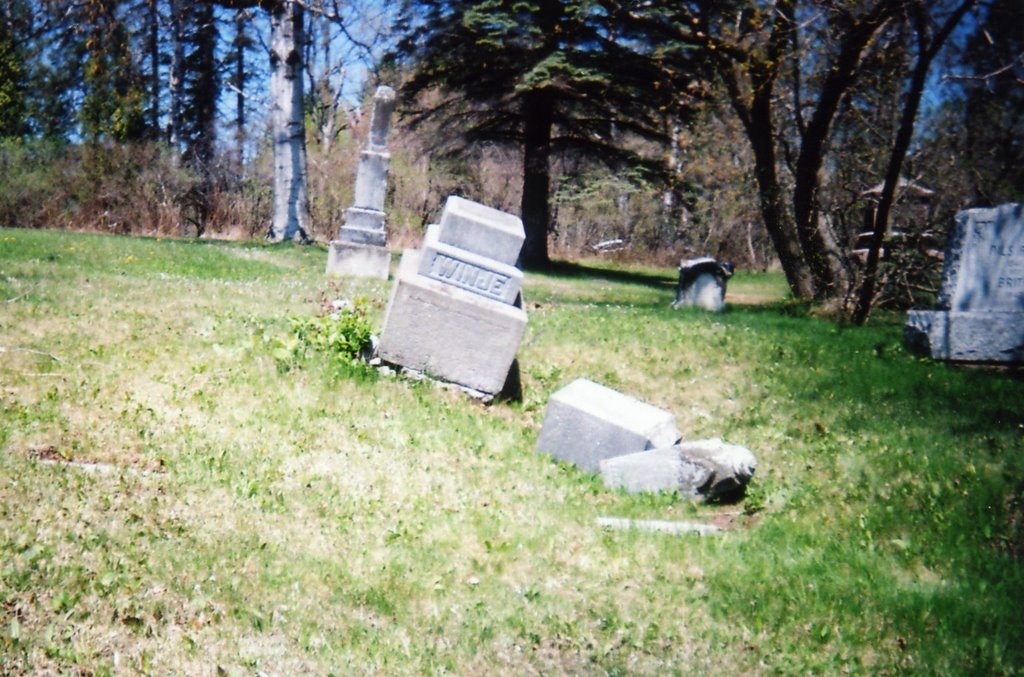
In the spring of this year I began a project to repair the broken 1888 Winje monument at Scandia Cemetery in Duluth, Minnesota. Although the bushes/trees alongside the base were cut to ground level last summer, the roots continued to grow and pushed the monument over soon afterwards. As the very first marker on the family plot, the five-foot granite stone records the deaths of three children born to Eric and Thibertina "Bertina" Winje:  Hattie, 5, and Annie, 2, both died from diphtheria within days of each other in the spring of 1888, and Louis drowned in a tragic boating accident at age 18 in August 1893. There have been delays with the monument company, but after several phone calls, I am told to expect an estimate shortly. In the meantime, the Duluth summer is ticking away.


Winje monument after the damage
(Photo by Gloria Conrad, April 2006,
Scandia Cemetery, Duluth, Minnesota.)

A BIG "thank you" to those who have sent donations. A portion of the money was used to do the final engraving on Emma T. Winje's flat marker stone, also at Scandia. When she was buried in Duluth in 1970, after passing away at a nursing home in Fridley, Minnesota, the year of her death was not engraved. Emma was born on her parents' Chippewa prairie homestead in Granite Falls Township in 1879. During her long life, she was a teacher, millner, care-taker, piano-instructor, stenographer, and election clerk, among other things: truly a female "jack of all trades." She was also a beloved daughter, sister, aunt, and friend to many. Because of family cooperation, we have now been able to complete that final task for Emma. That feels REALLY good, doesn't it?

Emma T. Winje
(Photo taken in Peoria, IL.)


In 1909, while living in Detroit Lakes, Minnesota, Emma and her older sister, Lena, were invited to accompany friends to a pow-wow at the White Earth Reservation. Their adventures are described in Chapter 3 of Kate Opened the Gate, memoirs written by Elsie Peterson Johnson, who was a young girl at the time.